
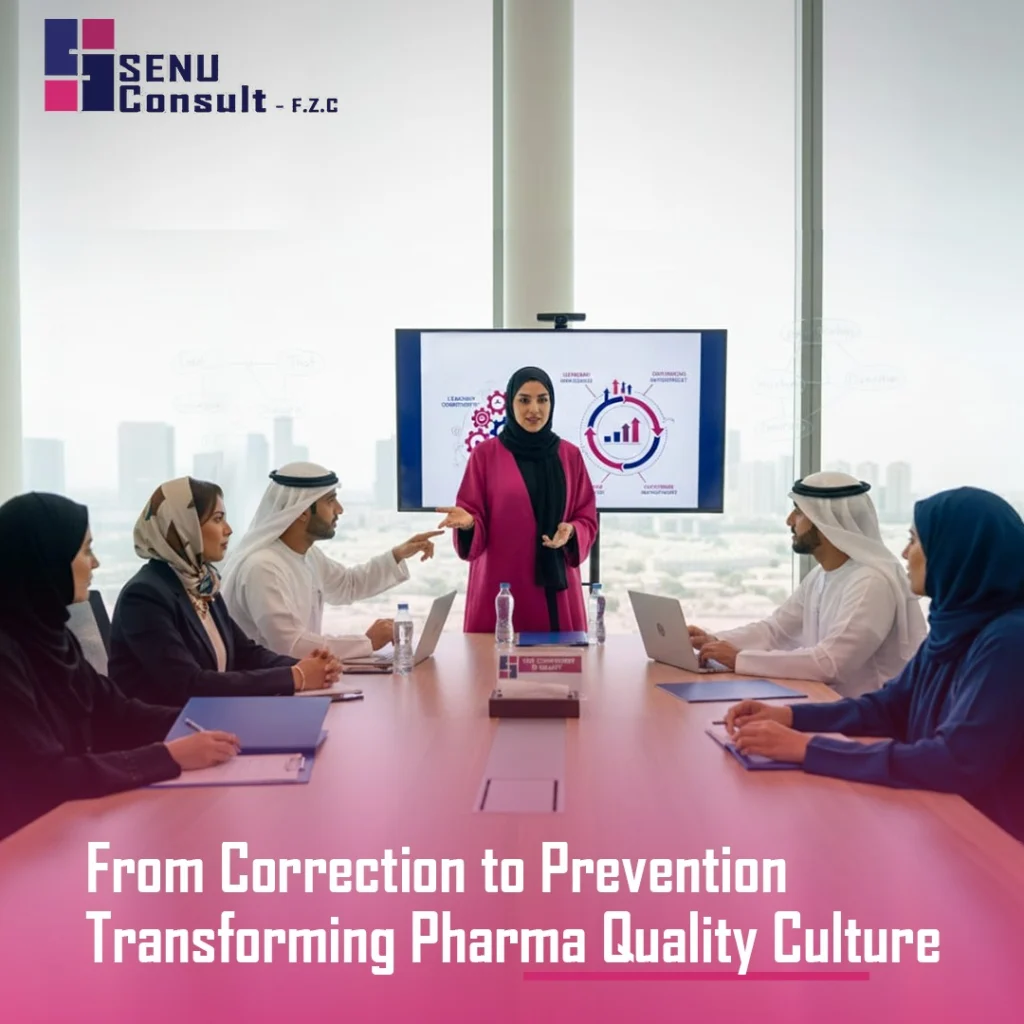
From Correction to Prevention: Transforming Pharma Quality Culture
Pharmaceutical organizations have traditionally demonstrated strong capability in correcting issues—closing deviations, responding to audit findings, and executing corrective actions with precision. However, industry research shows that many deviations are recurrent, exposing a gap between reactive correction and true preventive quality (McDermott et al., 2021, p. 44). In an increasingly complex global environment—shaped by evolving compliance requirements for pharmaceutical companies and frequent regulatory updates in the pharmaceutical industry—a prevention-centered quality culture is no longer optional. It is a strategic necessity for companies aiming to remain competitive among the best pharmaceutical consulting firms and highly regulated markets such as the pharma industries in the UAE.
This enhanced version deepens the analysis and integrates strategic insights relevant to pharmaceutical engineering consulting firms, pharma regulatory consulting firms, and organizations modernizing their quality, supply chain, and quality-by-design frameworks.
Reframing the Mindset
Traditional GMP environments often reward fast correction rather than proactive prevention. A modern prevention-driven quality culture emphasizes designing operations, facilities, and processes that inherently reduce the likelihood of deviations—an approach strongly supported by leading pharmaceutical plant design consultants.
Key actions include:
- Integrating patient-impact storytelling to build emotional commitment and long-term accountability (ISPE, 2019, p. 12).
- Redirecting KPIs from simple CAPA closure counts to metrics linked to risk prevention and early mitigation.
- Strengthening psychological safety to encourage reporting of early signals or weak points without fear of blame (Edmondson, 2018, p. 63).
This shift is particularly important when navigating global expectations for quality during technology transfer of pharmaceutical products across multiple sites.
Strengthening Root Cause Culture
Despite regulatory guidance, many organizations continue attributing failures to “human error” alone—often masking deeper systemic weaknesses (FDA, 2006, p. 25). Prevention requires a stronger, more structured investigation culture supported by tools commonly used by consulting firms in the pharmaceutical industry.
Recommended tools and methods:
- Failure Mode and Effects Analysis (FMEA) for forecasting and prioritizing risk.
- Bowtie Analysis to structure risk pathways and identify missing preventive barriers (CCPS, 2018, p. 92).
- 5 Whys + Barrier Analysis, linking behavioral factors to process vulnerabilities in a holistic manner.
This shift replaces the question “Who caused the error?” with “What system weakness allowed the error?”
Designing for Visibility
Unseen risks evolve into deviations. Enhanced visibility—particularly across the supply chain process in the pharmaceutical industry—is critical for achieving prevention.
Practical approaches include:
- Building early-warning dashboards that integrate deviations, audits, complaints, and change-control trends into a single visual platform (ISPE, 2020, p. 33).
- Using leading indicators such as first-time-right rates, equipment utilization, training quality, and environmental control data.
- Employing visual management tools including heatmaps, traffic-light systems, and error-proofing diagrams.
Visibility must extend beyond the manufacturing floor into quality control, technology transfer, supply chain, and vendor qualification.
Embedding Prevention into Processes
Prevention must be embedded into day-to-day operations, not treated as an add-on. Modern pharmaceutical supply chain consultants and facility designers increasingly embed digital tools, automation, and human-centred SOPs to reduce variation.
Key strategies:
- Integrating mandatory risk assessments at all critical decision points—change control, deviations, vendor qualification, and batch certification (ICH Q9(R1), 2023, p. 7).
- Designing SOPs grounded in human-factors engineering, using visuals and workflow aids (Gibson, 2019, p. 51).
- Leveraging automation and digital tracking systems to minimise manual steps and human variability while enhancing traceability and compliance.
This approach aligns with global trends in digital GMP and increased oversight by regulators and pharma regulatory consulting firms.
Empowering the Frontline
Operators, technicians, and supervisors are closest to the process and often detect early signals long before formal systems identify them. Successful organisations empower frontline staff as the first line of defence.
Empowerment practices:
- Conducting “prevention huddles” at shift changes to discuss potential risks or weak signals.
- Encouraging near-miss reporting through a non-punitive culture (Reason, 2016, p. 134).
- Rewarding preventive actions—rather than glorifying corrective “firefighting.”
This cultural empowerment is increasingly recognized by the best pharma consulting firms as a defining trait of high-maturity quality systems.
Closing the Loop with Effectiveness Checks
Many CAPAs address symptoms rather than root causes. A prevention-oriented culture requires rigorous effectiveness checks that consider system-wide interactions.
Strengthening the loop involves:
- Revising CAPA templates to ensure actions include preventive, systemic controls—not only local fixes.
- Using periodic trend analysis to identify patterns of recurrence over periods of 3–12 months (WHO, 2022, p. 41).
- Sharing lessons learned across departments and sites to reduce silo-based decision-making and increase global learning.
This aligns with modern GMP philosophies that emphasise proactive risk management across the entire product lifecycle.
The Payoff
When organizations shift from a corrective mindset to a prevention-driven culture, the benefits extend far beyond compliance:
- Fewer recurring deviations and stronger regulatory confidence
- Greater inspection readiness
- Increased operational flow, efficiency, and reduced rework
- Stronger performance during GMP certificate for pharmaceutical products inspections
- Improved reliability during technology transfer of pharmaceutical products
- Better integration of processes across quality, engineering, and supply chain
- Ultimately—greater patient safety
Correction fixes the past. Prevention protects the future.
References
- CCPS (2018) Bowties in Risk Management: A Concept Book for Process Safety. New York: Wiley.
- Edmondson, A. (2018) The Fearless Organisation. Hoboken: Wiley.
- FDA (2006) Quality Systems Approach to Pharmaceutical CGMP Regulations. U.S. Food and Drug Administration.
- Gibson, J. (2019) Human Factors in Process Safety. IChemE, pp. 43–68.
- ICH (2023) Q9(R1) Quality Risk Management. International Council for Harmonisation.
- ISPE (2019) Cultural Excellence Report. International Society for Pharmaceutical Engineering.
- ISPE (2020) Advancing Pharmaceutical Quality (APQ) Guide: Process Performance and Product Quality Monitoring System.
- McDermott, R., Waite, L. and Ralston, M. (2021) ‘Learning from Repeat Deviations’, Journal of GXP Compliance, 25(3), pp. 41–55.
- Reason, J. (2016) Managing the Risks of Organisational Accidents. Farnham: Ashgate.
- WHO (2022) Quality Risk Management: A Draft Guidance. World Health Organization.