
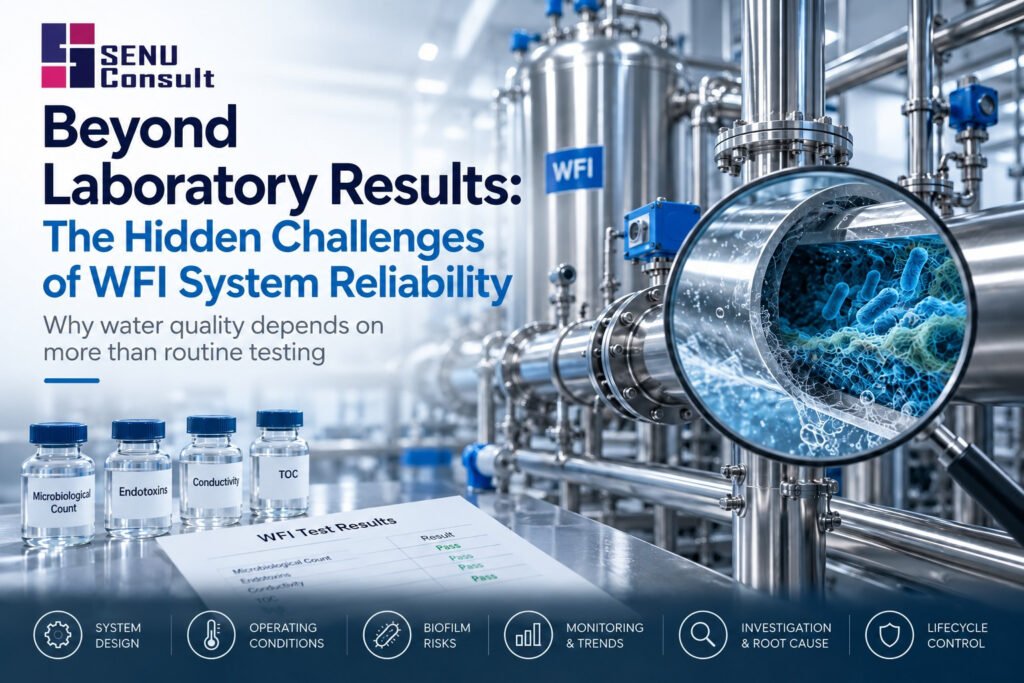
WFI System Reliability: Beyond Laboratory Results
Beyond Laboratory Results: The Hidden Challenges of WFI System Reliability in Pharmaceutical Manufacturing
Why Water Quality Depends on More Than Routine Testing
In pharmaceutical manufacturing, few utilities demand the same level of attention as Water for Injection (WFI). Its quality is essential to manufacturing processes where microbiological and chemical purity must be consistently maintained.
Yet one of the most significant challenges in managing pharmaceutical water systems is that laboratory results provide only part of the picture.
A sample collected from a distribution point may meet established specifications while conditions elsewhere in the system are gradually becoming less favorable. Changes in water circulation, temperature distribution, equipment condition, or microbial activity may develop between sampling events without producing an immediate out-of-specification result.
This creates an important distinction: meeting water quality specifications at a particular moment is not the same as demonstrating continuous control of the entire system.
For pharmaceutical manufacturers, understanding that difference is fundamental to long-term utility reliability and effective contamination control.
Understanding the WFI Distribution System as a Connected Process
WFI management is sometimes approached primarily through the performance of the generation unit and the results of routine quality testing.
However, the storage tank, circulation pumps, piping network, valves, instruments, and points of use must operate together as one integrated system.
Each component can influence the ability to preserve water quality after generation.
For example, a properly functioning WFI generation system cannot compensate for poor circulation in an isolated branch of the distribution network. Similarly, acceptable temperature readings at the main return line do not necessarily demonstrate that every location experiences equivalent conditions.
This is why an effective assessment must consider how water moves through the system, where operating conditions may differ, and whether the selected control measures remain effective during normal production.
The Engineering Details That Influence Water Quality
Several design characteristics deserve particular attention.
Piping configuration should reduce locations where water can remain stagnant. Valves and fittings must be suitable for hygienic service, while equipment arrangements should support inspection, maintenance, and sanitization.
Material selection is equally important. Properly specified and fabricated 316L stainless steel is widely used in WFI systems, but material quality alone does not guarantee hygienic performance.
Weld integrity, internal surface characteristics, drainage provisions, and the arrangement of connections all influence system cleanability and operational reliability.
A successful design therefore considers not only how the system will perform during initial qualification, but also how it will behave after years of operation, maintenance, and changing production demands.
Biofilm: A Potential Threat That May Develop Out of Sight
One of the more complex challenges in pharmaceutical water systems is the potential development of biofilm.
Unlike freely suspended microorganisms, biofilm-associated organisms attach to surfaces and exist within a structured matrix of extracellular polymeric substances.
This environment can make microbial contamination more difficult to detect and remove.
The concern is particularly relevant because microorganisms associated with internal surfaces may not be continuously present in the water collected for routine analysis.
Instead, microbial release may occur intermittently, potentially producing fluctuating monitoring results.
Consequently, repeated acceptable samples cannot independently establish that every internal surface is free from biofilm.
This does not mean that every fluctuation in microbial counts indicates biofilm. Sampling practices, laboratory variability, operating disturbances, and maintenance activities may also influence results.
A scientifically sound investigation is needed to identify the most likely cause.
Why Sanitization Effectiveness Must Be Demonstrated
Sanitization is an essential part of controlling microbiological risks, but its effectiveness depends on more than completing a scheduled cycle.
For thermal sanitization, the system must achieve appropriate conditions at the relevant locations for the required duration.
For chemical sanitization, factors such as concentration, contact time, distribution, material compatibility, and subsequent removal of the sanitizing agent may be important.
The selected strategy must be supported by qualification or validation evidence appropriate to the system and its intended use.
A documented sanitization cycle is valuable only when there is sufficient evidence that it can consistently achieve its defined objective.
Why Operating Conditions Deserve Continuous Attention
WFI systems are dynamic utilities.
Production schedules, water demand, maintenance interventions, and equipment changes can influence operating conditions.
A distribution network may perform differently during periods of high production demand compared with weekends, shutdowns, or low-use operating periods.
These variations should be considered when establishing the system’s operating strategy.
Temperature and circulation are especially important.
Many WFI systems use hot storage and distribution as part of their microbial control strategy. Other qualified system configurations may employ different approaches.
In either case, operating limits must reflect the selected technology, applicable requirements, and demonstrated system performance.
Circulation conditions should also be evaluated across different usage patterns, rather than assuming that a satisfactory reading at one location represents the entire network.
The central objective is to establish operating conditions that can be maintained reliably throughout the qualified system.
Turning Monitoring Data into Early Warning Signals
Pharmaceutical manufacturers routinely collect substantial amounts of data from WFI systems.
The challenge is ensuring that these records support meaningful operational decisions.
Microbiological test results, bacterial endotoxin measurements, conductivity, Total Organic Carbon (TOC), temperature, and circulation-related parameters each contribute different information about system performance.
When reviewed independently, they may provide only limited insight. When evaluated together over time, they can help reveal emerging trends.
For example, a gradual increase in microbial counts at a particular point of use may justify investigation even when individual results remain below established action limits.
Similarly, recurring temperature deviations or changes in circulation patterns may identify operating weaknesses before they result in a confirmed water quality failure.
The value of monitoring lies not only in confirming compliance, but also in recognizing when a previously stable system begins to behave differently.
Alert and action limits should be appropriately justified, and adverse trends should trigger proportionate investigation under the pharmaceutical quality system.
Investigating WFI Deviations Beyond the Test Result
When an unexpected WFI result occurs, the investigation should extend beyond the laboratory finding itself.
A useful starting point is to determine whether the event appears isolated or reflects a broader system condition.
The investigation may need to consider:
• Whether results from nearby sampling locations show similar behavior.
• Whether the sampling procedure or sample handling could have influenced the finding.
• Whether recent operating changes affected temperature or circulation.
• Whether maintenance work introduced new contamination risks.
• Whether the sanitization process reached the relevant system locations.
• Whether the event has occurred previously under comparable conditions.
Reviewing these factors together can help distinguish a temporary event from a developing system weakness.
Where appropriate, the investigation should also evaluate potential impacts on manufacturing activities and affected product batches.
Corrective actions should address substantiated causes rather than relying automatically on repeated testing or additional sanitization.
Maintaining Reliability Throughout the System Lifecycle
A WFI system is not permanently assured simply because it passed its initial qualification.
Over time, component replacements, maintenance activities, changes in production demand, and modifications to operating procedures can alter its performance.
Maintaining a qualified state requires coordinated engineering and quality-management activities throughout the system’s operational life.
Initial commissioning and qualification establish documented evidence that the installed system can perform as intended.
Routine monitoring and preventive maintenance help confirm that this performance continues.
Change control evaluates whether modifications could affect established operating conditions or water quality.
Deviation management and Corrective and Preventive Action (CAPA) processes address unexpected events and recurring weaknesses.
Periodic reviews bring these activities together to assess whether the system remains adequately controlled.
This lifecycle perspective transforms WFI management from a collection of individual technical tasks into a coordinated reliability strategy.
The Relationship Between Engineering, Quality, and Operational Readiness
One of the most valuable improvements pharmaceutical manufacturers can make is to connect WFI engineering decisions with quality requirements from the earliest project stages.
When design, commissioning, qualification, and routine operation are treated as separate activities, important system risks may remain unresolved until late in the project.
A more integrated approach allows teams to establish clear performance expectations, identify critical components, define testing requirements, and prepare appropriate operational documentation before the system enters routine service.
It also supports smoother transitions between engineering contractors, equipment suppliers, validation teams, quality departments, and manufacturing personnel.
For both new installations and existing facilities, collaboration between these functions is essential to sustainable utility performance.
Building a Defensible WFI Control Strategy
There is no single combination of operating temperature, circulation rate, or sanitization frequency that can be applied universally to every pharmaceutical water system.
System configuration, intended use, production requirements, and applicable regulatory expectations must guide the selection of appropriate controls.
Relevant references include applicable pharmacopoeial requirements, EU GMP Annex 1 where relevant, WHO guidance on pharmaceutical water systems, and other applicable GMP requirements.
Operating limits, monitoring locations, acceptance criteria, and sanitization procedures should be supported by appropriate technical justification, system qualification data, and approved documentation.
A defensible WFI control strategy demonstrates not only that the water meets required specifications, but also that the engineering and operational measures used to preserve its quality are appropriate and effective.
Conclusion: Managing the System, Not Just the Sample
The long-term reliability of a WFI system cannot be determined from laboratory results alone.
Water quality reflects the combined performance of system design, operating conditions, maintenance practices, sanitization processes, and quality oversight.
Although routine testing remains indispensable, it is most effective when supported by engineering knowledge, historical performance analysis, and proactive risk management.
For pharmaceutical manufacturers, the priority should be to understand how the entire distribution system behaves and ensure that potential contamination risks remain controlled throughout its lifecycle.
Reliable WFI quality is achieved through a well-managed system—not simply a series of acceptable laboratory results.
Senu Consult | Pharmaceutical Engineering and Operational Excellence
At Senu Consult, we believe that dependable pharmaceutical manufacturing begins with engineering decisions supported by sound technical evidence and a clear understanding of operational risk.
Connecting system design, commissioning, qualification, and ongoing performance management helps organizations strengthen the reliability of critical utilities and build confidence in their manufacturing infrastructure.
Effective contamination control begins with understanding the system behind the test results.