
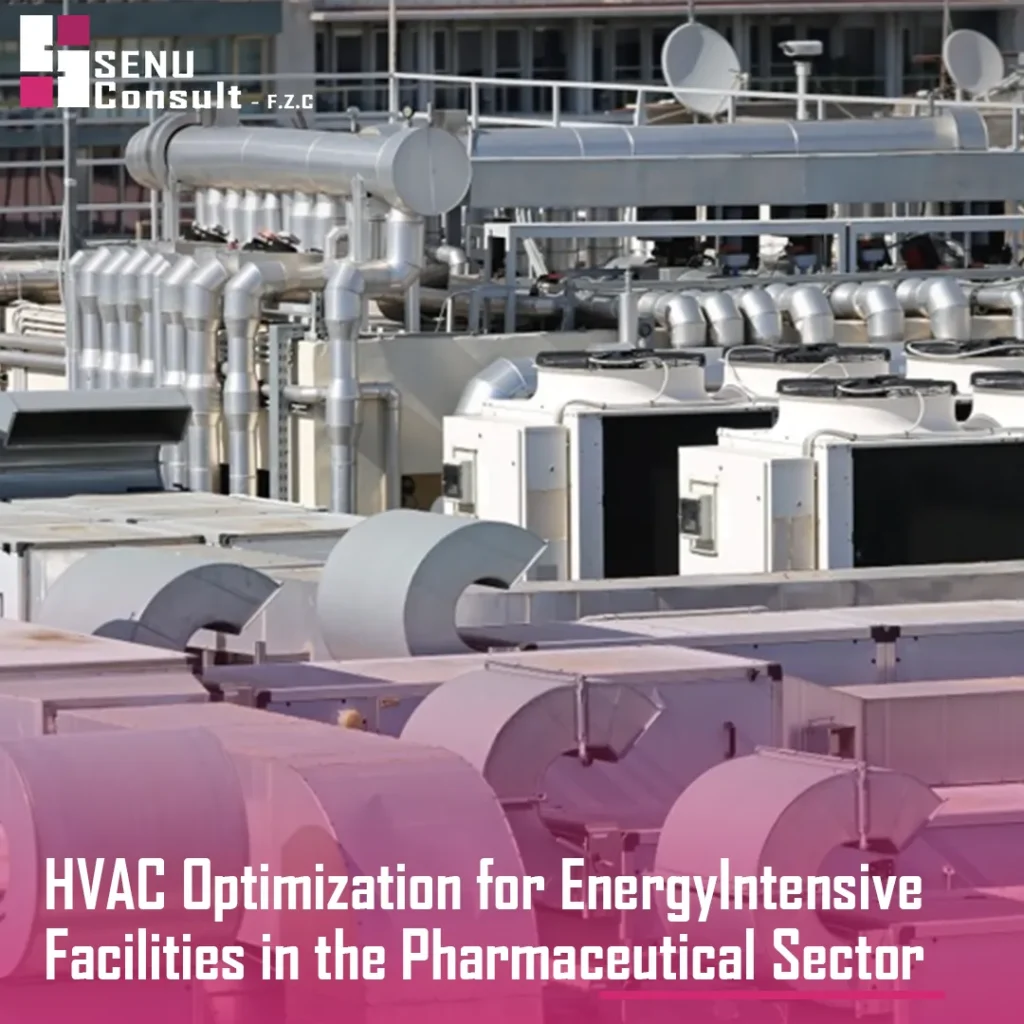
HVAC Optimization for Energy‑Intensive Facilities in the Pharmaceutical Sector
In energy‑intensive environments such as pharmaceutical manufacturing plants and cleanrooms, HVAC systems often represent the most significant portion of operational energy consumption. Given rising energy costs, stringent regulatory requirements for air quality (e.g., GMP, ISO), and increasing pressure for sustainability — particularly in regions like the UAE — optimising HVAC design and control is both an environmental and business imperative. This article explores four advanced HVAC strategies — demand‑controlled ventilation, integration of heat recovery chillers with desiccant dehumidification, model‑based airflow cascade control, and energy‑saving approaches as guided by the World Health Organization (WHO) Technical Report Series (TRS) — and shows how they can deliver substantial energy savings while ensuring compliance, operational efficiency, and robust air quality.
By combining real‑time ventilation control, humidity‑optimized dehumidification, predictive airflow management, and design principles rooted in WHO TRS guidance, pharmaceutical facilities can significantly reduce HVAC energy use without compromising cleanroom standards — a compelling value proposition for consulting firms pharmaceutical industry, pharmaceutical plant design consultants, and other stakeholders in pharma industries in UAE and beyond.
WHO TRS Energy‑Saving Approach: A Risk‑Based, Lifecycle Strategy
The WHO TRS guidance for HVAC design in non-sterile pharmaceutical manufacturing emphasizes a science- and risk‑based approach to design, operation, qualification, and maintenance of HVAC systems (WHO, 2017; WHO, 2019).
Key energy-saving principles include:
- Risk assessment at design stage: HVAC systems should be sized and specified based on contamination and process requirements rather than default assumptions (WHO, 2017).
- Avoidance of over‑specification: Oversized air change rates, filtration, and pressure cascades lead to unnecessary energy consumption (WHO, 2019).
- Lifecycle perspective: HVAC systems should be designed, commissioned, validated, and maintained to sustain energy efficiency throughout their operational life (WHO, 2017).
WHO TRS encourages tailored HVAC design aligned with actual operational needs, providing a foundation for energy efficiency, compliance, and cost-effectiveness (WHO, 2017).
Deployment of Demand‑Controlled Ventilation
Why Demand‑Controlled Ventilation (DCV) Matters
Traditional cleanroom HVAC systems operate at fixed high air‑change rates (ACH) 24/7 to ensure air quality, regardless of actual occupancy or contaminant load. This results in excessive energy use, with HVAC systems consuming the majority of a cleanroom’s operational energy (Pharmaceutical Manufacturing, 2025).
Demand‑controlled ventilation (DCV) adjusts ventilation dynamically based on real-time data such as occupancy or particle concentration, reducing ACH during low occupancy periods and increasing airflow only when necessary (Cleanroom Technology, 2014).
How Real-Time Data Enables DCV
Sensors monitoring occupancy, airborne particle counts, CO₂, humidity, and other metrics enable BMS integration. Intelligent fan-speed modulation using variable-speed drives can reduce fan energy consumption by 30–50% (Cleanroom Industries, 2023). Case studies report energy savings of up to 70% for fan operation while maintaining cleanroom classification (Cleanroom Industries, 2023).
Benefits for Pharmaceutical Facilities
- Energy savings: Significant reduction in fan and chiller energy consumption (Pharmaceutical Manufacturing, 2025).
- Maintained compliance: Ensures required cleanliness, pressure differentials, and recovery times (Cleanroom Technology, 2014).
- Lower maintenance costs: Reduced wear on equipment extends operational life (Cleanroom Industries, 2023).
DCV represents a key strategy for pharmaceutical plant design consultants and best pharma consulting firms to deliver sustainable, energy-efficient cleanroom solutions (Pharmaceutical Manufacturing, 2025).
Integration of Heat Recovery Chillers and Desiccant Dehumidification
Addressing Latent Load
High-humidity zones impose substantial latent loads on HVAC systems. Conventional chillers managing both sensible and latent loads often operate inefficiently, increasing energy consumption (ISPE, 2024).
How Desiccant Dehumidification Helps
Decoupling sensible and latent cooling via desiccant wheels removes moisture before air reaches the chiller. This reduces chiller load, improving energy efficiency. Regenerable desiccant systems leveraging waste heat enhance sustainability and reduce operational costs (Cleanroom Industries, 2023).
Benefits of Integration
- Reduced chiller load: Offloading humidity removal enhances chiller efficiency (ISPE, 2024).
- Precise humidity control: Supports compliance with GMP certificate for pharmaceutical products (WHO, 2017).
- Operational efficiency in humid climates: Particularly relevant for pharma industries in UAE (Cleanroom Industries, 2023).
- Synergy with heat recovery: Waste heat from chillers regenerates desiccants, optimising energy use (ISPE, 2024).
Advanced Airflow Cascade Control via Model‑Predictive Algorithms
Limitations of Traditional Control
Legacy HVAC systems rely on fixed setpoints or simple feedback loops, often leading to inefficient operation and difficulty maintaining cleanroom standards (ISPE, 2024).
Advantages of Model Predictive Control (MPC)
MPC uses mathematical models to anticipate future conditions, adjusting airflow, temperature, and humidity proactively. Integration with BMS enables coordinated control across zones, achieving up to 60% energy reduction in total HVAC consumption in simulation studies (Cleanroom Industries, 2023; ISPE, 2024).
Implementation Strategies
- Real-time monitoring of occupancy, particle counts, and environmental parameters.
- Predictive adjustment of supply, exhaust, and recirculation airflow.
- Coordination with desiccant dehumidification and heat recovery units to optimise latent and sensible load management.
- Validation for compliance with pressure cascades, cleanliness levels, and recovery times (WHO, 2017).
Integration of WHO TRS Energy-Saving Principles
In addition to technology-specific strategies, WHO TRS recommends:
- Right-sizing systems: Avoid overspecification to prevent unnecessary energy use (WHO, 2019).
- Lifecycle efficiency: Consider energy use during design, commissioning, operation, and maintenance (WHO, 2017).
- Risk-based approach: Tailor HVAC performance to actual process needs, ensuring safety and product quality while reducing energy demand (WHO, 2017).
By embedding these principles, pharmaceutical plant design consultants can enhance sustainability and compliance while optimizing operational costs (WHO, 2019).
Conclusion
Optimizing HVAC in pharmaceutical facilities is critical for balancing regulatory compliance, product quality, operational cost, and sustainability. The combination of demand‑controlled ventilation, heat recovery chillers with desiccant dehumidification, model‑predictive airflow cascade control, and WHO TRS-aligned energy-saving principles provides an effective framework for reducing energy consumption while maintaining high-quality cleanroom environments.
For pharmaceutical plant design consultants, consulting firms pharmaceutical industry, and best pharma consulting firms, implementing these strategies demonstrates value to clients through cost savings, compliance assurance, and sustainability credentials — key differentiators in the competitive pharmaceutical sector (Pharmaceutical Manufacturing, 2025; Cleanroom Industries, 2023; WHO, 2017).
read more:
Advanced Water System Design and Management for Pharma Facilities
Facility Design & Project Management
References
Cleanroom Industries, 2023. Pharmaceutical cleanroom design & energy efficiency: cleanroom calculations and energy‑saving measures. [online] Available at: https://www.cleanroom-industries.com/en/resources/item/537-pharmaceutical-cleanroom-design-iso-14644-16 [Accessed 1 Dec. 2025].
Cleanroom Technology, 2014. Quality compliant HVAC energy reduction in pharmaceutical facilities. [online] Available at: https://www.cleanroomtechnology.com/quality-compliant-hvac-energy-reduction–94561 [Accessed 1 Dec. 2025].
ISPE, 2024. Good Practice Guide: Heating, Ventilation & Air Conditioning (2nd Edition). [online] Available at: https://ispe.org/publications/guidance-documents/good-practice-guide-heating-ventilation-air-conditioning-hvac [Accessed 1 Dec. 2025].
Pharmaceutical Manufacturing, 2025. Improving energy efficiency in HVAC, boilers and cogeneration for pharmaceutical operations. [online] Available at: https://www.pharmamanufacturing.com/facilities/facility-design-management/article/11364802/improving-energy-efficiency-in-pharmaceutical-manufacturing-operations-part-ii-hvac-boilers-and-cogeneration-pharmaceutical-manufacturing [Accessed 1 Dec. 2025].
World Health Organization (WHO), 2017. Guidelines on heating, ventilation and air‑conditioning systems for non‑sterile pharmaceutical products (TRS 1010 – Annex 8). Geneva: WHO. [online] Available at: https://www.who.int/docs/default-source/medicines/norms-and-standards/guidelines/production/trs1010-annex8-who-gmp-heating-ventilation-airconditioning.pdf [Accessed 1 Dec. 2025].
World Health Organization (WHO), 2019. Good manufacturing practices for heating, ventilation and air‑conditioning systems for non‑sterile pharmaceutical products – Part 2: Interpretation of guidelines (TRS 1019 – Annex 2). Geneva: WHO. [online] Available at: https://cdn.who.int/media/docs/default-source/medicines/norms-and-standards/guidelines/production/trs1010-annex8-who-gmp-heating-ventilation-airconditioning-part2.pdf [Accessed 1 Dec. 2025].