
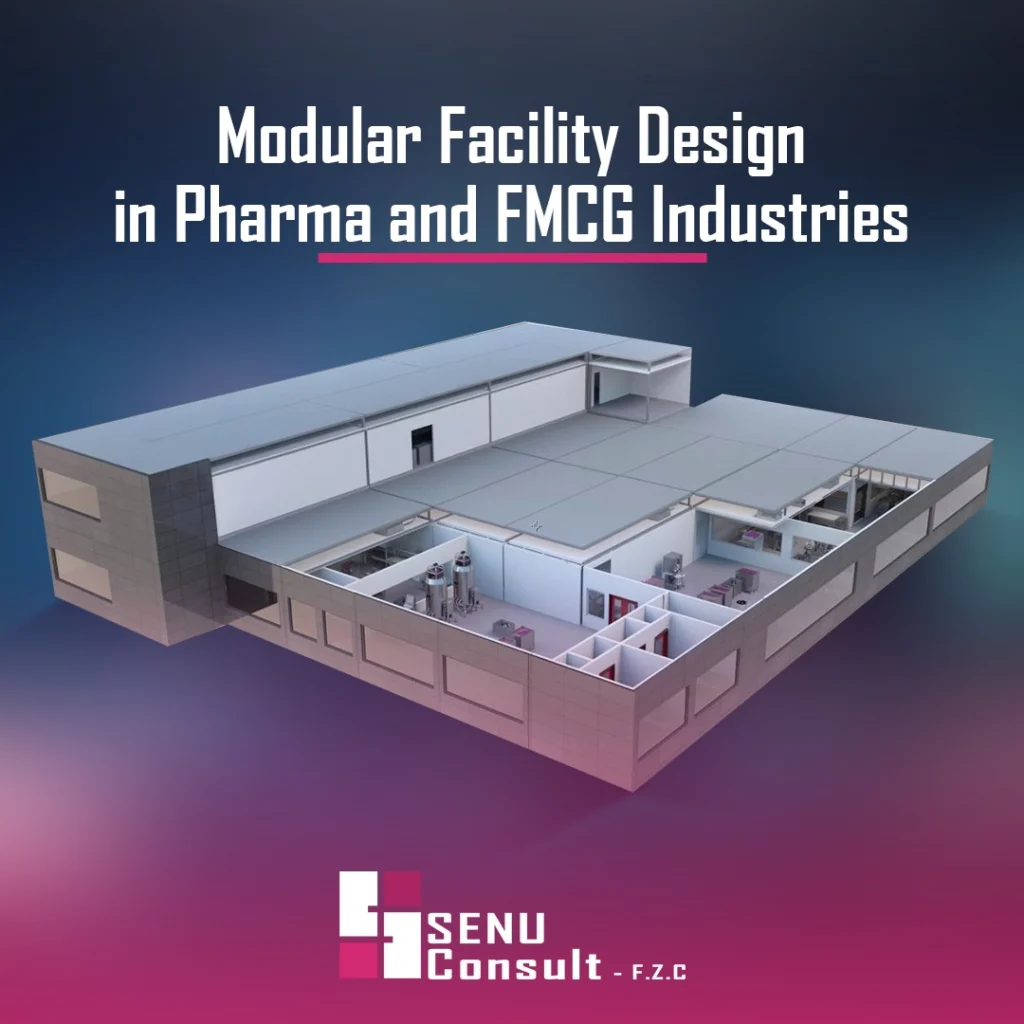
Modular Facility Design in Pharma and FMCG Industries
In today’s rapidly evolving manufacturing landscape, modular facility design has become a strategic priority for organizations seeking agility and efficiency. This is particularly visible in the pharmaceutical industry and the fast-moving consumer goods (FMCG) sector, where companies increasingly partner with pharmaceutical engineering consulting firms and pharmaceutical plant design consultants to modernise operations and strengthen competitiveness. As regulatory standards advance and global markets shift—especially within rapidly growing regions such as the pharma industries in the UAE—modular design offers a scalable pathway for operational excellence. This article explores the benefits, applications, and challenges of modular facility design in both pharma and FMCG environments.
Modular Facility Design in the Pharmaceutical Industry
Modular construction in pharma typically involves prefabricated modules such as cleanrooms, process “pods”, and utility skids that are built off-site and then assembled on location (Pharmadule, n.d.). These solutions are widely adopted by consulting firms in the pharmaceutical industry seeking faster deployment and stricter Good Manufacturing Practice (GMP) controls.
A major driver behind modular adoption is its positive impact on the supply chain process in the pharmaceutical industry. By shifting fabrication to controlled environments, modular construction reduces project delays, supports predictable scheduling, and mitigates contamination risks (ISPE, 2024). This controlled approach is essential when navigating compliance requirements for pharmaceutical companies, particularly for firms pursuing or maintaining a GMP certificate for pharmaceutical products.
Speed is another compelling advantage. Modular facilities can reduce total project timelines by up to 50 %, enabling faster readiness for regulatory inspections and accelerating the technology transfer of pharmaceutical products from development to commercial scale (Hanson, 2024, p. 3). Such efficiency is invaluable given the frequent regulatory updates in the pharmaceutical industry, which require companies to adapt swiftly and demonstrate robust qualification processes (IQ, OQ, PQ).
Furthermore, many pharma regulatory consulting firms now recommend modular designs because pre-validation in factory-controlled settings ensures greater accuracy during commissioning and qualification activities. This creates a repeatable and compliant facility model aligned with GMP and ISO 14644 standards.
Yet, these benefits require extensive early-stage planning. Modular execution shifts design risks to the project’s front end, demanding strong coordination between engineering, qualification, and supply chain teams (Pharmamanufacturing, 2012). Choosing the best pharmaceutical consulting firms can alleviate these complexities by providing expertise in site layout, module integration, HVAC design, and cleanroom classification.
Modular Facility Design in the FMCG Industry
In the FMCG sector, modularity is primarily applied to process skids, conveyors, and automation subsystems. Modular skids—containing pumps, sensors, controls, and utilities—are prefabricated and delivered as plug-and-play units, enabling rapid installation and configuration (Arcadia Equipment, n.d.).
This approach brings significant agility. FMCG operations often require fast recipe changes, packaging adjustments, or capacity expansions. Modular skids and conveyors allow operators to reconfigure lines quickly, reducing downtime and improving responsiveness to consumer demand (GTF Technologies, 2025). For food and beverage manufacturers, modular systems also support sanitation compliance by enabling tool-less disassembly and efficient cleaning (Processing Magazine, 2025).
Modular designs extend beyond production lines. Warehousing and distribution facilities increasingly use prefabricated structures for fast deployment and scalability. This supports companies operating across high-growth regions such as the Middle East, where modular distribution hubs allow businesses to respond swiftly to market fluctuations (Saudi Construction Consulting, 2023).
Sustainability is an additional advantage. Off-site fabrication minimizes waste, while reconfigurable modules reduce the need for complete system replacements, aligning with environmentally responsible manufacturing strategies.
Comparing Pharma and FMCG Modular Approaches
While both industries benefit from modularisation, their objectives differ:
- Pharma focuses on regulatory compliance, contamination control, validation, and alignment with GMP. Partnerships with pharmaceutical supply chain consultants and pharmaceutical engineering consulting firms are common to ensure quality and regulatory readiness.
- FMCG prioritises operational flexibility, rapid line changeovers, and responsiveness to consumer dynamics.
Pharmaceutical manufacturers may adapt entire modular buildings (cleanrooms, labs, utilities), whereas FMCG companies typically modularise subsystems such as conveyors or skids.
Challenges and Risks
Despite its benefits, modular facility design carries challenges:
- Higher upfront engineering costs, especially for detailed design and specification.
- Supply chain risks, including module transportation damage or fabrication delays.
- Integration issues, particularly when connecting new modular elements to legacy infrastructure.
- Limited late-stage design flexibility, as modules are manufactured early and modifications can be complex.
To navigate these challenges, many companies collaborate with the best pharma consulting firms or multidisciplinary engineering partners capable of overseeing design, validation, and regulatory alignment across the entire project lifecycle.
Conclusion
Modular facility design is transforming both pharmaceutical and FMCG industries by enabling faster project execution, greater flexibility, and cost-effective scalability. In the pharmaceutical sector, modular approaches strengthen GMP compliance, accelerate technology transfer of pharmaceutical products, and reduce supply chain complexities. In FMCG, modular skids and conveyor systems enhance agility and support rapid market-driven change. As organisations respond to global competition, regulatory developments, and environmental pressures, modular facility design—supported by specialist pharmaceutical engineering consulting firms and high-quality system integrators—offers a future-proof pathway to building resilient and efficient operations.
References
- Arcadia Equipment (n.d.) Modular Process Skids for Food & Beverage Products. Available at: https://arcadiaequipment.com/modular-process-skids-for-food-beverage. (Accessed: 17 November 2025).
- Bornholdt, P., et al. (2021) [Industry report referenced in original text].
- Deiiang (2024) 7 Essential Trends in Modular Cleanrooms for Pharmaceuticals. Deiiang Cleanroom Equipment.
- GCC Cleanroom (n.d.) Transform Your Pharmaceutical Operations with Modular Cleanrooms. GCC Cleanroom.Globe Newswire (2023) Insights on the Modular
- Manufacturing Facilities in Pharmaceutical and Biotechnology Global Market to 2035. Globe Newswire.
- GTF Technologies (2025) The Importance of Modular Design in Today’s Manufacturing. GTF Technologies.
- Hanson, P. (2024) Innovative Modular Facility Design. International Society for Pharmaceutical Engineering (ISPE), pp. 3–5.
- ISPE (2024) Balancing Speed and Quality in the Construction of Pharmaceutical Facilities. International Society for Pharmaceutical Engineering.
- Khazna (2025) [Industry report referenced in FMCG modular distribution].
- Pharmadule (n.d.) Modular Solutions for Manufacturing Facilities. Pharmadule®.
- Pharmamanufacturing (2012) Modular Construction in Pharma: No Longer a Novelty. PharmaManufacturing.
- Pharmamanufacturing (2024) Improving Modular Builds Depreciation and ATMP Adaptability. PharmaManufacturing, p. 12.
- Processing Magazine (2025) How Modular Conveyor Systems Support Agile Production in Food and Beverage Applications. Processing Magazine.
- Saudi Construction Consulting (2023) Speed and Sustainability in FMCG Distribution Center Design. Saudi Construction Consulting.
- Zeton (2019) Smallscale Flexible Plants: Modular Factory Concepts. Zeton.