
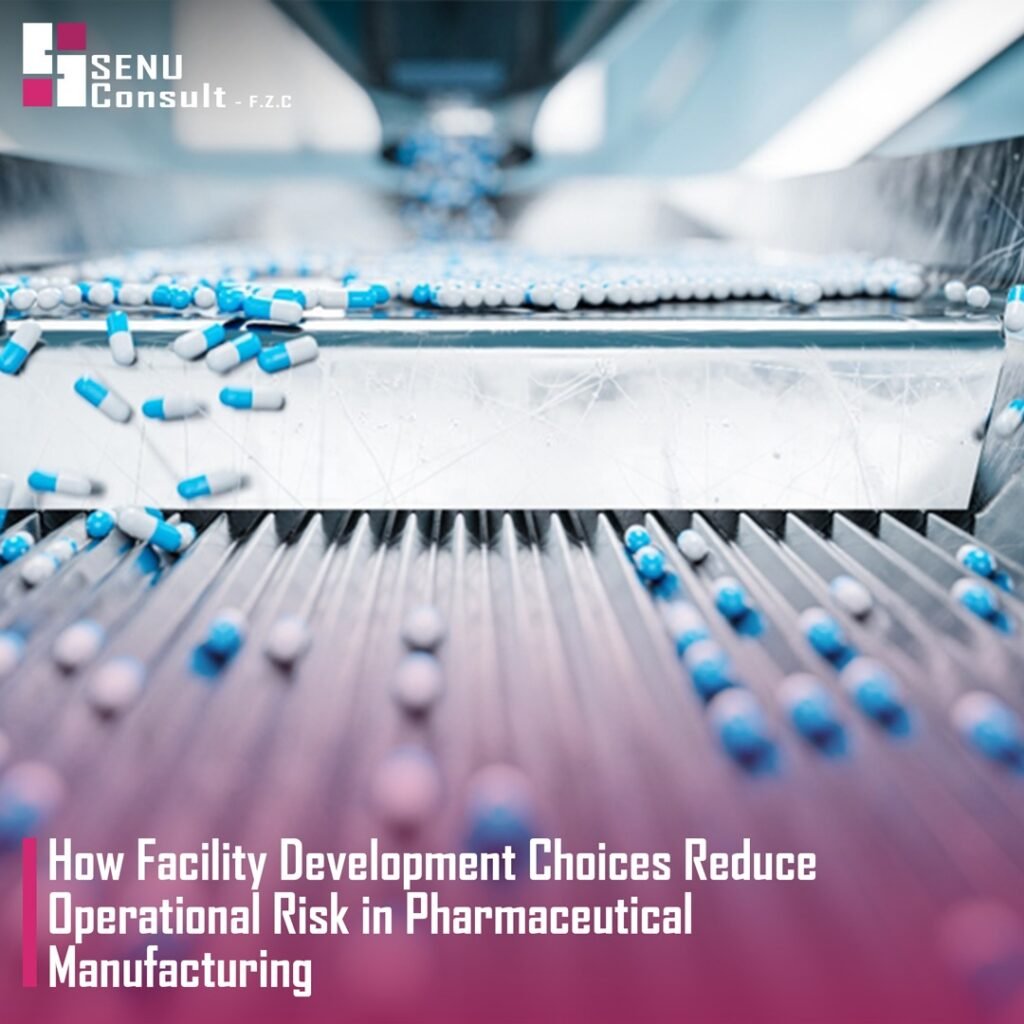
Pharmaceutical facility development
How Facility Development Choices Reduce Operational Risk in Pharmaceutical Manufacturing
Introduction
Operational risk in pharmaceutical manufacturing is often linked to deviations, inspection findings, or supply interruptions. However, many of these risks begin much earlier. They start during facility development.
Decisions made during concept design, layout planning, and infrastructure selection shape the operational risk profile of a manufacturing site for decades. As a result, strategic facility development can significantly reduce operational risk before production even begins.
Facility Development as the First Line of Risk Control
Pharmaceutical facilities must operate in a constant state of control. Achieving this state becomes easier when companies embed risk mitigation into the facility design from the outset.
Poor layout logic, limited utility capacity, or restricted maintenance access create hidden risks. Over time, these risks appear as recurring deviations, unplanned downtime, and compliance challenges. Therefore, a facility-first approach treats risk control as a design objective rather than an operational correction.
Layout and Flow Decisions That Minimise Operational Risk
Clear and logical material, personnel, and waste flows represent some of the most effective risk-reduction tools during facility development. Proper segregation reduces the likelihood of mix-ups and cross-contamination. It also lowers procedural complexity.
Facilities designed with short and intuitive flows require fewer manual interventions. Consequently, they reduce reliance on operator judgment and lower the risk of human error. This approach improves day-to-day operational stability.
Utilities and Infrastructure Reliability
Utilities form the backbone of pharmaceutical manufacturing operations. HVAC systems, purified water, compressed air, and power supply directly support product quality and process control.
When utility systems lack capacity or redundancy, production interruptions become more likely. For this reason, facility development choices must prioritise robustness, redundancy, and maintainability. These decisions reduce the risk of unplanned shutdowns and simplify qualification and performance monitoring activities.
Maintenance Accessibility and Lifecycle Risk
Operational risk extends beyond routine production activities. Maintenance, calibration, and servicing introduce frequent interventions into controlled environments. When facilities are difficult to maintain, the probability of errors and contamination events increases.
Designing facilities with maintenance accessibility in mind reduces these risks. Service corridors, adequate equipment spacing, and effective isolation capabilities support safer interventions. As a result, lifecycle risk decreases and operational continuity improves.
Flexibility as a Risk Mitigation Strategy
Pharmaceutical markets change continuously. Product portfolios evolve, volumes increase, and regulatory expectations shift. Inflexible facilities struggle to adapt and quickly become high-risk assets.
Facilities designed with flexibility and future expansion in mind absorb change more easily. Therefore, manufacturers can implement new requirements without extensive rework or prolonged shutdowns. This adaptability protects long-term investment value and reduces strategic risk.
Integrated Facility Development and Risk Management
Treating facility development as part of an integrated risk management strategy delivers long-term benefits. Early alignment between engineering, quality, and operations reduces dependence on procedural controls and reactive fixes.
At Senu Consult, facility development services focus on embedding risk control into design decisions from the earliest project stages.
🔗 https://senuconsult.com/
This integrated approach supports predictable compliance, operational resilience, and sustainable manufacturing performance.
Conclusion
Operational risk in pharmaceutical manufacturing is largely determined during facility development. By making informed design and infrastructure choices early, manufacturers reduce reliance on procedural controls and improve operational predictability.
Facility development is therefore not only an engineering activity. It is a foundational risk management strategy that supports long-term compliance and business continuity.
Call to Action
Planning a new pharmaceutical facility or upgrading an existing site?
Consult with the Senu Consult facility development specialists to design a manufacturing site that proactively reduces operational risk.
🔗 https://senuconsult.com/