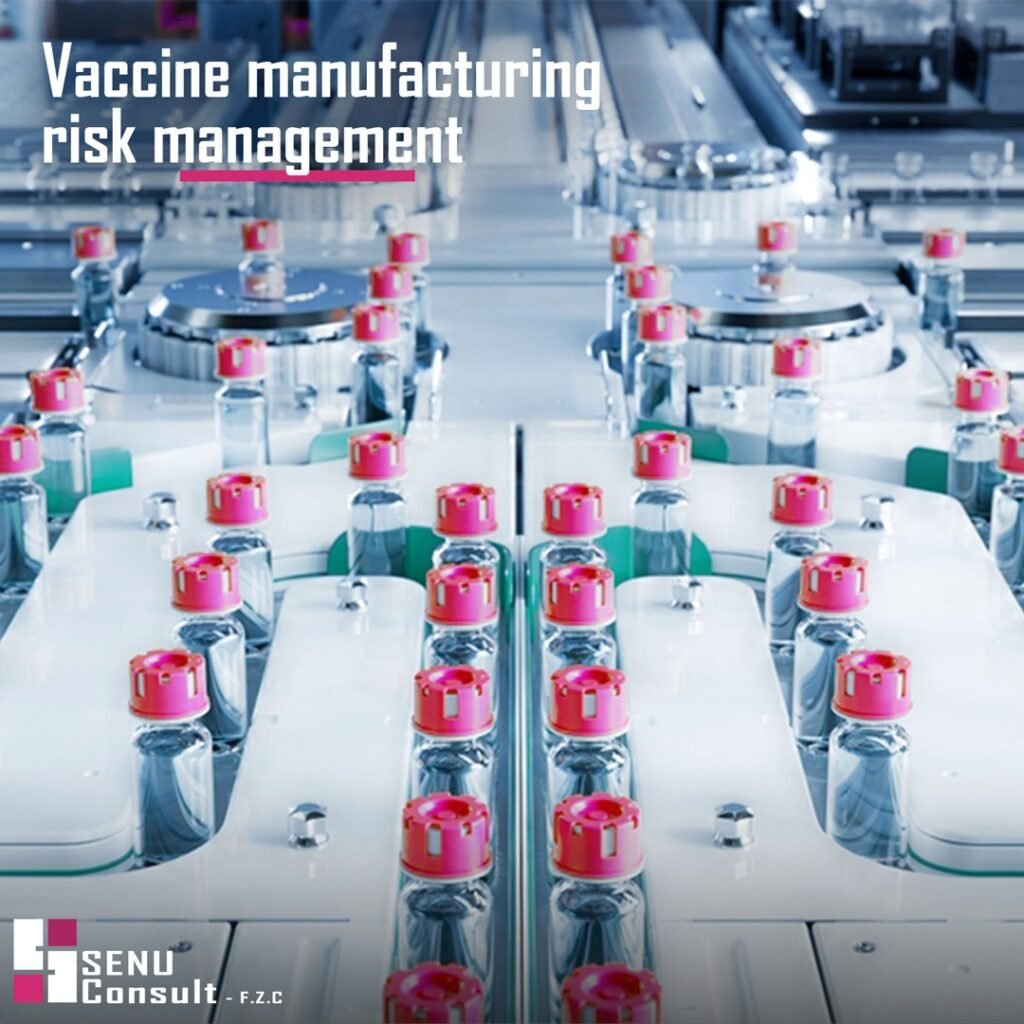
Vaccine manufacturing risk management
What Vaccine Manufacturing Teaches You About Risk: Strategic Lessons for the Pharmaceutical Industry
Vaccine manufacturing risk management
Introduction
Why vaccine manufacturing is the best “risk classroom” in pharma
Vaccine manufacturing is one of the most risk-intensive activities within the pharmaceutical industry. Few sectors operate under such continuous regulatory scrutiny, compressed timelines, and high public exposure. From contamination control to cold-chain integrity, the tolerance for error is extremely low. Therefore, vaccine manufacturing offers powerful lessons on how risk should be understood, managed, and designed out—lessons that directly matter for pharmaceutical engineering consulting firms, pharma regulatory consulting firms, and pharmaceutical supply chain consultants operating across global markets, including the pharma industries in the UAE.
Risk Is a System Outcome, Not a Single Failure
Why risk usually comes from the system, not one incident
Vaccine manufacturing risk management
One of the most important lessons from vaccine manufacturing is that risk rarely starts from a single mistake. Instead, it often emerges from systems that teams never designed to withstand real operational pressure.
Regulatory bodies consistently emphasize that quality and safety cannot be tested into pharmaceutical products; rather, teams must embed them through facility design, validated processes, and robust quality systems (WHO, 2016, pp. 84–86). This becomes especially clear in vaccine manufacturing, because aseptic processing failures often trace back to early design choices instead of daily operational negligence.
For pharmaceutical plant design consultants, this reinforces a critical point: design decisions are risk decisions. For example, weak material and personnel flows, poor zoning concepts, or insufficient HVAC segregation may comply on paper, yet still fail during routine operations.
Industry Example: Facility Design and Contamination Risk
How layout and segregation weaknesses show up in inspections
Vaccine manufacturing risk management
A well-documented regulatory trend involves contamination events linked to facility layout weaknesses. For instance, FDA warning letters frequently cite deficiencies in pressure cascades, airflow patterns, and inadequate segregation between classified and non-classified areas (FDA, 2011, p. 6).
In vaccine facilities, such failures can trigger full batch rejection and prolonged production shutdowns. Moreover, the same risk applies to sterile injectables, biologics, and advanced therapies. That is why best pharmaceutical consulting firms increasingly integrate GMP compliance requirements into early-stage design, rather than treating them as post-construction validation work.
The Asymmetry of Risk in Pharmaceutical Operations
Why small deviations can create huge consequences
Vaccine manufacturing highlights the asymmetric nature of risk in regulated industries. In other words, minor deviations can produce disproportionate outcomes.
For example, a brief temperature excursion during vaccine storage, even if corrected quickly, can invalidate stability data and disrupt national immunization programs. Regulatory guidance makes clear that authorities do not evaluate excursions only by duration; they also evaluate the potential impact on product quality and patient safety (EMA, 2017, pp. 10–11).
This lesson applies directly to the pharmaceutical supply chain process. Therefore, pharmaceutical supply chain consultants increasingly focus on cold-chain risk mapping, data integrity, and supplier qualification—not because failures happen every day, but because their impact can be severe.
Industry Example: Supply Chain Vulnerability
What COVID-19 disruptions revealed about global supply chains
During the COVID-19 pandemic, vaccine manufacturers faced shortages of critical raw materials such as single-use bioreactor components and glass vials. As a result, these disruptions exposed weaknesses in global pharmaceutical supply chains and highlighted the importance of supplier diversification and risk-based sourcing strategies (WHO, 2020, pp. 22–24).
Consequently, consulting firms in the pharmaceutical industry now put greater emphasis on supply chain resilience, localization strategies, and technology transfer of pharmaceutical products to regional manufacturing hubs, including the Middle East.
Technology Transfer as a Risk Multiplier
Why transfer work increases exposure if governance is weak
Vaccine manufacturing also shows how technology transfer can amplify risk when teams do not manage it systematically.
Transferring vaccine production from an originator site to a new facility involves more than replicating equipment. Teams must transfer tacit knowledge, operator behavior, and process sensitivity alongside documentation. ISPE notes that poorly managed technology transfer is a leading cause of post-approval deviations and regulatory observations (ISPE, 2019, pp. 18–20).
This lesson matters for pharmaceutical engineering consulting firms supporting new facilities or localization initiatives. Without strong technology transfer governance, organizations risk delayed GMP certification for pharmaceutical products and longer regulatory engagement.
Industry Example: Regional Manufacturing Expansion
Why UAE and regional hubs face higher expectations for readiness
Several pharma industries in the UAE have invested heavily in vaccine and biologics manufacturing to strengthen national healthcare resilience. At the same time, regulators in the region increasingly expect facilities to demonstrate not only GMP compliance, but also strong knowledge transfer, data integrity, and operational readiness before licensure.
Therefore, this trend increases the value of pharma regulatory consulting firms that can bridge global regulatory expectations with local execution realities.
Data Integrity Is Risk Management
Why regulators treat data integrity failures as system failures
In vaccine manufacturing, data integrity failures represent systemic risks, not simple documentation mistakes. Regulators often link incomplete records, uncontrolled spreadsheets, and undocumented interventions to deeper governance weaknesses (MHRA, 2018, pp. 4–5).
As a result, best pharma consulting firms now treat digitalization as a risk-control strategy. For example, electronic batch records, manufacturing execution systems (MES), and validated IT infrastructure have become risk control tools rather than only efficiency improvements.
Moreover, even peripheral activities—such as website design for pharmaceutical companies—are increasingly scrutinized for data accuracy, product claims, and regulatory alignment. Therefore, risk governance now extends beyond the factory floor.
Speed Without Discipline Increases Exposure
Why fast timelines demand stronger controls, not weaker ones
Emergency vaccine rollouts proved an important point: speed does not reduce regulatory expectations. Instead, accelerated pathways require stronger controls, clearer accountability, and more disciplined change management (FDA, 2020, p. 3).
This lesson matters for organizations pursuing rapid scale-up, mergers, or portfolio expansion. Without execution discipline, speed can magnify weaknesses rather than create advantage.
Leadership and Risk Culture
Why culture determines whether risk stays visible or hidden
Perhaps the most enduring lesson from vaccine manufacturing is cultural. Leadership behavior determines whether teams surface risk early or hide it until it becomes unmanageable.
Regulators increasingly assess organizational culture during inspections, because culture strongly influences compliance outcomes and product quality (EMA, 2017, p. 14). In vaccine manufacturing, where public trust is central, transparency and accountability are non-negotiable.
Therefore, for consulting firms serving the pharmaceutical industry, this reinforces the need to advise not only on facilities and systems, but also on governance models and decision-making frameworks.
Conclusion: Risk Is Designed, Not Discovered
Vaccine manufacturing teaches that risk is not an abstract concept to manage after problems happen. Instead, risk is the direct outcome of how organizations design facilities, execute technology transfer, manage supply chains, and govern behavior.
Whether advising on pharmaceutical plant design, regulatory compliance requirements, or supply chain optimization, the lesson remains clear: risk begins at concept design and ends with leadership accountability.
Organizations that internalize these lessons do more than achieve compliance. Moreover, they build resilience, credibility, and long-term operational confidence in an increasingly regulated world.
References (Harvard Style)
EMA (2017) Guideline on Good Manufacturing Practice specific to Advanced Therapy Medicinal Products. European Medicines Agency, London, pp. 9–14.
FDA (2011) Process Validation: General Principles and Practices. U.S. Food and Drug Administration, Silver Spring, MD, pp. 5–7.
FDA (2020) Emergency Use Authorization for Vaccines. U.S. Food and Drug Administration, Silver Spring, MD, pp. 2–4.
ISPE (2019) ISPE Baseline® Guide, Volume 5: Commissioning and Qualification. International Society for Pharmaceutical Engineering, Tampa, FL, pp. 18–20.
MHRA (2018) GxP Data Integrity Guidance and Definitions. Medicines and Healthcare products Regulatory Agency, London, pp. 3–6.
WHO (2016) WHO Technical Report Series No. 999: GMP for Biological Products. World Health Organization, Geneva, pp. 80–90.
WHO (2020) Guidance on Developing a National Deployment and Vaccination Plan for COVID-19 Vaccines. World Health Organization, Geneva, pp. 22–25.