
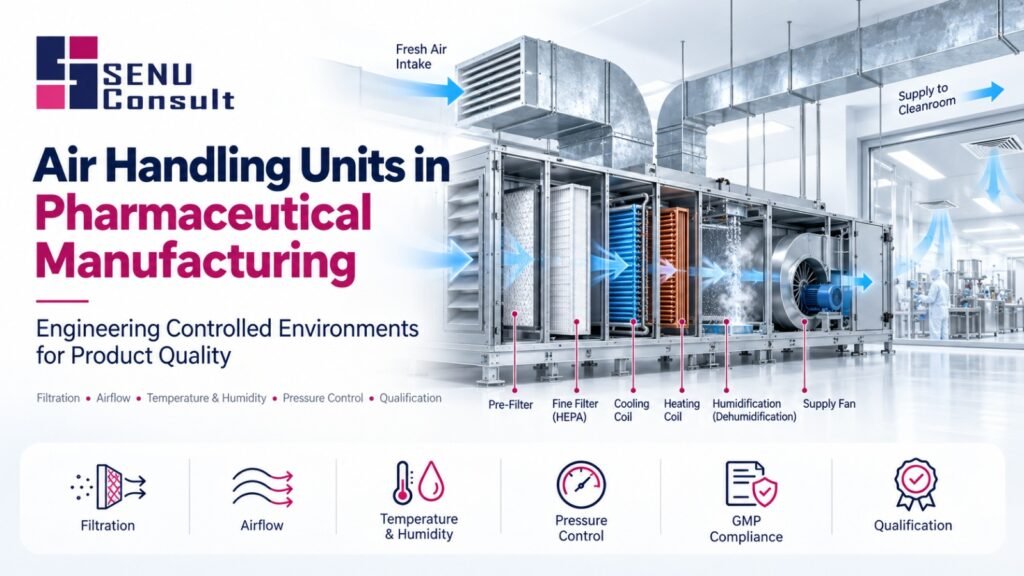
Air Handling Units in Pharmaceutical Manufacturing
Air Handling Units in Pharmaceutical Manufacturing: Engineering Controlled Environments for Product Quality
Why Pharmaceutical HVAC Performance Goes Beyond Heating and Cooling
In pharmaceutical manufacturing, maintaining a controlled production environment is a fundamental part of protecting product quality, supporting process consistency, and meeting Good Manufacturing Practice (GMP) expectations.
While production equipment and manufacturing processes often receive the greatest attention, the infrastructure responsible for maintaining environmental conditions is equally important.
Among the essential components of this infrastructure is the Air Handling Unit (AHU).
An AHU forms part of the Heating, Ventilation, and Air Conditioning (HVAC) system, conditioning and distributing air according to the requirements of the manufacturing facility.
However, its role in pharmaceutical operations extends far beyond providing comfortable temperatures.
Depending on the manufacturing application, the AHU contributes to airborne particulate control, temperature and humidity management, airflow distribution, and the pressure relationships that help limit contamination and cross-contamination.
For pharmaceutical manufacturers, effective AHU performance is therefore an engineering and quality-management consideration rather than simply a building-services requirement.
1. Understanding the Role of Air Handling Units in Pharmaceutical Facilities
An Air Handling Unit is an engineered assembly designed to process and deliver air at defined conditions.
Its configuration depends on the intended application, environmental requirements, production activities, and facility design.
In a pharmaceutical manufacturing environment, an AHU may serve production rooms, controlled corridors, laboratories, material-handling areas, or other spaces requiring environmental control.
A properly designed system must support several objectives simultaneously:
• Deliver the required quantity of conditioned air.
• Support the specified level of airborne particulate cleanliness.
• Maintain suitable temperature and relative humidity.
• Contribute to the required room pressure relationships.
• Provide airflow patterns compatible with contamination-control objectives.
• Maintain stable performance under different operating conditions.
These functions are interconnected.
For example, a change in supply airflow may influence room pressure, while an increase in filter resistance can affect the ability of the system to maintain its required operating conditions.
Consequently, AHU performance should be evaluated in relation to the complete HVAC network and the manufacturing spaces it serves.
2. How an AHU Conditions and Distributes Air
Understanding the movement of air through an AHU helps explain why equipment configuration is important.
Depending on the system design, outdoor air may be introduced and combined with recirculated air from the facility.
The resulting airstream passes through selected treatment stages before being supplied to the required areas.
Air Intake and Mixing Arrangements
The intake arrangement determines how outdoor and return air enter the system.
Where recirculation is permitted, the proportion of outdoor and return air should reflect ventilation requirements, contamination risks, and the applicable control strategy.
Dampers and associated controls regulate the movement of air through these sections.
In certain pharmaceutical applications, particularly where hazardous substances or significant cross-contamination risks exist, recirculation may be restricted or require additional safeguards.
Air Filtration
Filtration reduces airborne particles entering or circulating within the controlled environment.
Different filtration stages may be employed depending on the required air quality.
Pre-filters and secondary filters can protect downstream components and improve overall system performance.
Where high-efficiency particulate air (HEPA) filtration is required, the filtration arrangement, installation integrity, and testing requirements should be established according to the room classification and applicable standards.
HEPA filters may be installed within the AHU, in ductwork, or at terminal supply locations, depending on the design.
Cooling and Heating Sections
Thermal conditioning allows the system to maintain the required air temperature.
Cooling coils remove heat from the airstream and may also contribute to moisture removal when air is cooled below its dew point.
Heating coils provide temperature adjustment when required and may support reheating following dehumidification.
The selection and control of these components must consider the environmental requirements of the manufacturing process.
Fans and Air Movement
The fan assembly provides the pressure needed to move air through the AHU, ductwork, filters, and associated distribution components.
Fan selection should account for design airflow, system resistance, operating flexibility, and energy efficiency.
Variable-speed control may be used where appropriate to respond to changing system demands.
Humidity Control
Humidity management is particularly important for pharmaceutical products and processes sensitive to moisture.
Depending on the application, the AHU may include humidification equipment, dehumidification arrangements, or a combination of cooling and reheating.
The selected approach should maintain the required environmental conditions without introducing unacceptable contamination risks.
Instrumentation and Automation
Sensors, actuators, controllers, and alarm systems provide the information and control functions required for reliable AHU operation.
Typical monitored variables include air temperature, relative humidity, differential pressure, airflow-related parameters, and filter pressure drop.
These components allow operators to identify deviations and confirm that the HVAC system is operating within approved limits.
3. Why Airflow Management Matters for Contamination Control
Air movement within pharmaceutical facilities must be considered in relation to the manufacturing process and the potential sources of contamination.
Simply delivering filtered air into a room is not sufficient to demonstrate that the space is adequately protected.
The location of supply diffusers, return grilles, extraction points, doors, and equipment can influence airflow patterns.
Poorly designed arrangements may produce undesirable air movement or areas with insufficient effective air distribution.
Room Pressure Relationships
Pressure differences between adjoining areas may be used as part of a contamination-control strategy.
Positive pressure relationships can help limit the entry of less-clean air into protected spaces.
Negative pressure may be appropriate where containment of hazardous materials or airborne contaminants is required.
The selected pressure arrangement must reflect the risks associated with the process rather than following a universal pressure configuration.
Airflow and Air Change Requirements
The required airflow volume and air change rate depend on factors such as room classification, heat loads, contamination sources, occupancy, and process requirements.
Higher airflow does not automatically mean better contamination control.
Air distribution effectiveness, pressure stability, and the interaction between supply and extraction arrangements must also be considered.
Cross-Contamination Prevention
In facilities manufacturing different products or handling materials with differing risk profiles, HVAC design can play an important role in preventing unintended transfer of contaminants.
Appropriate segregation, pressure control, filtration, air movement, and extraction arrangements should be established through documented risk assessment.
4. AHU Design Considerations That Influence Long-Term Performance
Effective pharmaceutical AHU design begins with clearly defined user requirements.
Before selecting equipment, the engineering team should understand the manufacturing activities, product characteristics, room conditions, and relevant regulatory expectations.
Important considerations include equipment accessibility, suitable construction materials, adequate access for cleaning, and properly designed condensate drainage.
Moisture accumulation inside an AHU deserves particular attention because poorly maintained drain pans or wet internal surfaces may create conditions favorable to microbial growth.
Filter replacement arrangements should minimize the risk of contaminating clean sections of the system.
Ductwork design should also consider pressure losses, leakage, accessibility, insulation, and air distribution requirements.
A technically suitable AHU is not necessarily the most powerful or most complex unit available.
It is the unit whose configuration and performance are appropriate for the intended manufacturing application.
5. Connecting AHU Performance with GMP Requirements
Pharmaceutical HVAC systems should be managed according to the applicable GMP framework and the risks associated with the manufacturing process.
For non-sterile pharmaceutical manufacturing, WHO guidance provides recommendations covering HVAC design, management, control, and qualification.
For sterile manufacturing, additional requirements may apply under frameworks such as EU GMP Annex 1, particularly where the HVAC system supports classified cleanroom environments.
The applicable requirements must be determined according to the type of manufacturing activity.
From a GMP perspective, manufacturers should be able to demonstrate that critical environmental conditions have been defined, justified, and appropriately controlled.
This generally requires documented system specifications, approved procedures, monitoring arrangements, maintenance records, and qualification evidence.
The aim is to establish a system capable of maintaining its intended environmental conditions consistently—not merely to show that the equipment operates mechanically.
6. Commissioning and Qualification: Verifying Performance Under Real Conditions
Successful installation does not automatically demonstrate that an AHU can maintain the environmental requirements of a pharmaceutical production area.
Commissioning and qualification provide the structured evidence needed to assess system performance.
Commissioning
Commissioning activities verify that equipment and associated services have been installed and configured appropriately.
These activities may include mechanical inspections, electrical checks, fan operation, damper movement, instrumentation checks, controls testing, and initial airflow balancing.
Installation Qualification (IQ)
IQ provides documented verification that the installed system complies with approved design specifications and relevant installation requirements.
Operational Qualification (OQ)
OQ evaluates whether the system performs as intended across defined operating conditions.
Testing may address control functions, alarms, airflow performance, temperature and humidity control, and other critical operating parameters.
Performance Qualification (PQ)
PQ provides evidence that the HVAC system can consistently support the required environmental conditions under representative operational circumstances.
Depending on the application, qualification may include room classification, airflow measurements, room pressure verification, recovery testing, airflow visualization, and other scientifically justified tests.
The qualification strategy should be established according to system criticality, intended use, and regulatory requirements.
7. Monitoring AHU Performance Throughout Its Lifecycle
HVAC performance can change over time.
Filter loading, fan wear, sensor drift, blocked drains, control-system changes, and alterations to manufacturing activities may affect previously qualified conditions.
An effective monitoring strategy should therefore consider both the immediate operating status and longer-term performance trends.
Important indicators may include:
• Supply and return air conditions.
• Room temperature and relative humidity.
• Differential pressure between relevant areas.
• Filter pressure drop.
• Fan performance and airflow parameters.
• Alarm frequency and recurring deviations.
• Maintenance history and equipment condition.
The monitoring frequency and alarm limits should reflect the criticality of the controlled environment.
Trend analysis can help identify progressive deterioration before the system becomes unable to meet its intended requirements.
8. Energy Efficiency Without Compromising Pharmaceutical Quality
Energy consumption is a major consideration in HVAC system operation.
Fans, cooling equipment, heating systems, and humidity-control processes may represent a significant proportion of facility utility demand.
However, energy optimization in pharmaceutical environments requires particular care.
Reducing airflow or modifying operating schedules without assessing contamination-control requirements may negatively affect room conditions or the qualified state of the facility.
Opportunities for improvement may include efficient fan selection, appropriate variable-speed control, optimized filtration arrangements, effective thermal control, and improved maintenance practices.
Any modification affecting critical environmental conditions should undergo documented impact assessment and, where necessary, additional qualification.
Energy efficiency should be achieved through controlled engineering optimization, not by compromising the environmental conditions required for manufacturing.
9. Common AHU Performance Problems and Their Potential Causes
Problems in pharmaceutical AHU systems are not always caused by failure of the main equipment.
Sometimes, the underlying issue is an imbalance between system components or an inappropriate control strategy.
For example:
Unstable room pressure may result from changes in supply or extract airflow, door operation, filter loading, or control-system behavior.
Difficulty maintaining temperature may be associated with insufficient coil capacity, changing process heat loads, control-valve problems, or inadequate airflow.
Elevated humidity may indicate ineffective moisture removal, excessive moisture loads, or unsuitable control arrangements.
Repeated filter alarms may reflect filter loading, unexpected contamination sources, or incorrect pressure measurement.
Uneven room conditions may result from poor air distribution, equipment obstructions, or changes to the original room layout.
Effective troubleshooting requires an understanding of the complete HVAC arrangement rather than focusing exclusively on the AHU.
10. A Lifecycle Approach to Reliable Pharmaceutical HVAC Systems
The most effective pharmaceutical HVAC strategies connect initial engineering decisions with long-term operational requirements.
This begins with establishing clear user requirements and identifying critical environmental parameters.
The design should then translate those requirements into appropriate equipment specifications and control functions.
Commissioning and qualification provide documented evidence that the installed system can meet the intended performance requirements.
During routine operation, monitoring, maintenance, calibration, deviation management, and change control help sustain the qualified state.
Periodic review allows manufacturers to evaluate whether the system remains suitable as production demands and facility configurations evolve.
By approaching the AHU as part of an integrated quality-critical utility system, manufacturers can strengthen reliability, improve operational visibility, and reduce the risk of unexpected environmental deviations.
Conclusion: Air Handling Units Are Part of Pharmaceutical Quality Infrastructure
An Air Handling Unit is much more than a device for moving and conditioning air.
In pharmaceutical manufacturing, it contributes to the controlled environment required for reliable production, product protection, and regulatory compliance.
Its effectiveness depends on the interaction between filtration, thermal conditioning, airflow management, instrumentation, system design, and routine operational control.
For pharmaceutical manufacturers, the fundamental objective is not simply to install an AHU with suitable technical specifications.
It is to establish an HVAC system that consistently performs according to defined, justified, and qualified requirements.
Reliable pharmaceutical environments are engineered through integrated design, demonstrated performance, and continuous operational control.
Senu Consult | Connecting Engineering with Pharmaceutical Manufacturing Excellence
At Senu Consult, our approach to pharmaceutical engineering emphasizes the relationship between technical design, operational performance, and quality expectations.
Understanding how critical utility systems interact with manufacturing processes is essential to developing facilities that are reliable, maintainable, and prepared for long-term operational demands.
By connecting engineering decisions with qualification requirements and lifecycle performance considerations, pharmaceutical organizations can make more informed infrastructure investments and strengthen their approach to manufacturing excellence.
Effective pharmaceutical manufacturing begins with engineering systems designed for control, reliability, and sustainable performance.
Technical note: System design parameters, room classifications, filtration requirements, qualification tests, and operating acceptance criteria must be justified according to the intended manufacturing activity, applicable GMP regulations, relevant standards, and approved system documentation.
Frequently Asked Questions
What is the purpose of an AHU in pharmaceutical manufacturing?
An AHU conditions and distributes air to support defined environmental requirements, including temperature, humidity, filtration, and airflow. It works with the wider HVAC system to maintain appropriate manufacturing conditions.
What is the difference between an AHU and an HVAC system?
The AHU is one component of the HVAC system. It handles air treatment and movement, while the complete HVAC system also includes associated heating and cooling utilities, ductwork, controls, and distribution equipment.
Are HEPA filters required in all pharmaceutical AHUs?
No. HEPA filtration requirements depend on the intended application, cleanroom classification, contamination-control strategy, and applicable regulations. HEPA filters may also be located at terminal air supply points rather than inside the AHU.
Why is differential pressure important in pharmaceutical facilities?
Differential pressure can help control the direction of air movement between adjacent rooms, supporting product protection or containment according to the manufacturing risks.
How are AHUs qualified in pharmaceutical manufacturing?
Qualification typically follows a documented, risk-based approach that may include installation, operational, and performance qualification, with testing selected according to the system’s intended use.
How can pharmaceutical manufacturers improve AHU efficiency?
Manufacturers can assess fan performance, filter resistance, controls, maintenance practices, and thermal conditioning efficiency. Any changes affecting critical environmental conditions must be evaluated through appropriate change control.
Technical References
For regulatory grounding, I recommend these references rather than citing the LinkedIn post as the article’s technical authority:
• WHO TRS 1010, Annex 8 — GMP guidelines for HVAC systems in non-sterile pharmaceutical manufacturing.
• WHO TRS 1019, Annex 2 — Technical interpretation and explanatory guidance for pharmaceutical HVAC systems.