
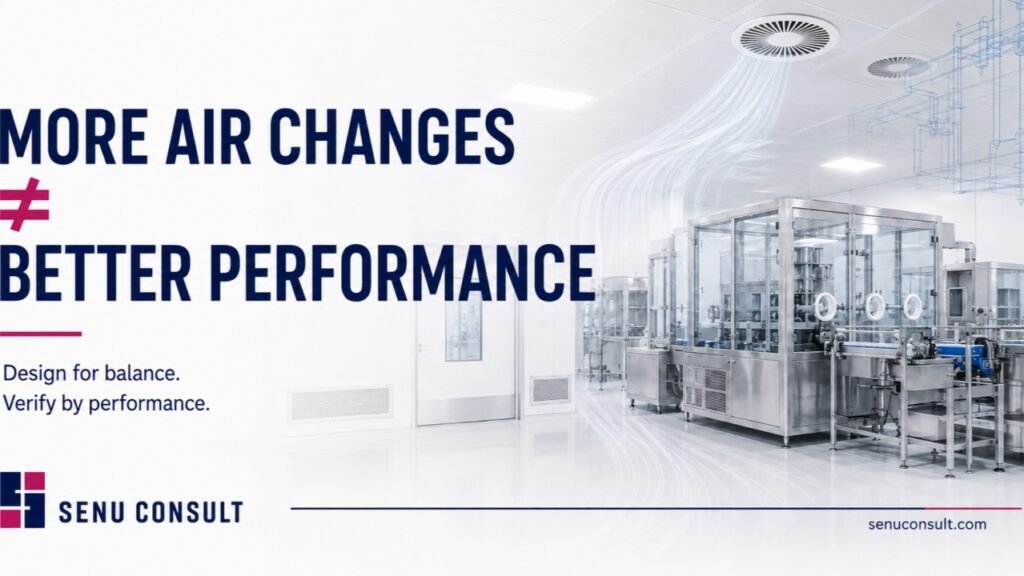
Cleanroom Air Change Rates
Why Higher Cleanroom Air Change Rates Don’t Always Improve Performance
In pharmaceutical facility design, Cleanroom Air Change Rates are often treated as a simple indicator of cleanroom performance. A common assumption is that increasing the number of air changes per hour (ACH) automatically creates a cleaner, safer, and more compliant environment.
However, this is not always the case.
Higher airflow does not necessarily mean better cleanroom performance. In fact, unnecessarily high air change rates can increase energy consumption, complicate HVAC operation, and create additional challenges without delivering proportional improvements in contamination control.
Therefore, Cleanroom Air Change Rates should be determined by actual process requirements, contamination risks, room conditions, and required performance rather than by arbitrary design figures.
What Are Cleanroom Air Change Rates?
The air change rate describes how many times the volume of air within a room is theoretically replaced during one hour. It is commonly expressed as Air Changes per Hour (ACH).
In pharmaceutical cleanrooms, ACH is an important HVAC design parameter. However, it is only one part of a much larger cleanroom performance strategy.
A cleanroom must ultimately demonstrate that it can maintain the required environmental conditions and cleanliness classification during its intended operating conditions.
Therefore, the focus should not simply be:
“How many air changes does this room have?”
Instead, the more important question is:
“Does the cleanroom consistently achieve the required performance?”
Cleanroom Air Change Rates Are a Design Parameter, Not the Final Goal
A high ACH value may appear to provide an additional safety margin. Nevertheless, cleanroom compliance cannot be demonstrated through airflow volume alone.
The actual objective is to maintain the required cleanliness level according to applicable GMP requirements and ISO 14644 classification.
This requires several systems and design elements to work together.
For example, cleanroom performance depends on airflow distribution, filtration efficiency, room pressure, temperature, humidity, equipment layout, personnel movement, process activities, and contamination sources.
As a result, increasing airflow without considering these factors may provide little practical benefit.
Why Excessively High Air Change Rates Can Create Problems
Increasing Cleanroom Air Change Rates beyond what the process actually requires may introduce several operational and financial disadvantages.
Higher HVAC Energy Consumption
Moving larger volumes of conditioned air requires more fan energy. Furthermore, the air must often be cooled, heated, filtered, and dehumidified before entering the cleanroom.
Consequently, unnecessarily high airflow can significantly increase the facility’s energy consumption.
This becomes particularly important in pharmaceutical facilities where HVAC systems may operate continuously.
Increased Cooling and Dehumidification Loads
More airflow can also increase the burden on cooling and humidity-control systems.
Depending on external conditions and internal process loads, the HVAC system may need additional capacity to maintain the required temperature and relative humidity.
Therefore, selecting excessive airflow during design can lead to larger equipment and higher operating costs throughout the facility lifecycle.
Impact on HEPA Filter Performance and Maintenance
HEPA filtration is a critical component of pharmaceutical cleanroom design.
However, increasing airflow through the system can affect pressure drops, filter loading, system balancing, and maintenance requirements.
In addition, inappropriate system sizing may contribute to shorter filter service intervals and increased maintenance costs.
For this reason, airflow requirements should be evaluated as part of the complete filtration and HVAC strategy.
More Airflow Does Not Automatically Mean Better Air Distribution
Air volume and airflow pattern are not the same thing.
A room may have a high number of air changes while still experiencing poorly controlled airflow in critical locations.
For example, inappropriate supply or return positions may create areas where particles are not removed efficiently. Equipment can also obstruct airflow paths, while room geometry may create unexpected circulation patterns.
Therefore, effective cleanroom design must consider both airflow quantity and airflow distribution.
Excessive Airflow Can Create Unwanted Turbulence
Higher air velocity can sometimes create unnecessary turbulence within a cleanroom.
This turbulence may influence particle movement and potentially redistribute contamination rather than removing it effectively.
Moreover, equipment, personnel, doors, and process activities continuously interact with airflow during operation.
For this reason, airflow should support the contamination-control strategy rather than simply maximize air movement.
Pressure Differentials Can Become More Difficult to Control
Pharmaceutical facilities frequently use pressure cascades to control contamination movement between adjacent spaces.
However, maintaining these pressure relationships depends on a carefully balanced supply, return, and exhaust strategy.
Excessive airflow can make system balancing more complicated. Additionally, door openings, exhaust systems, process equipment, and changing operating conditions may influence room pressure.
Therefore, Cleanroom Air Change Rates must be considered alongside pressure-cascade requirements.
What Actually Determines Cleanroom Performance?
Reliable cleanroom performance results from multiple engineering and operational factors working together.
These include:
- Required GMP grade and ISO classification
- Supply and return airflow locations
- HEPA filtration
- Room dimensions
- Process activities
- Personnel occupancy
- Equipment arrangement
- Particle generation
- Heat loads
- Pressure differentials
- Temperature and relative humidity
- Cleaning and disinfection practices
- Personnel and material movement
- Contamination-control measures
Therefore, ACH should never be evaluated as an isolated number.
Instead, designers should examine the complete interaction between the process, facility, HVAC system, personnel, and contamination risks.
Start With the Process, Not an Arbitrary ACH Number
A more reliable cleanroom design starts by understanding what actually happens inside the room.
First, engineers should define the required GMP grade and ISO classification.
Next, they should evaluate room dimensions, process activities, equipment loads, personnel occupancy, contamination sources, heat generation, and environmental requirements.
The assessment should also consider:
- Pressure-cascade requirements
- Recovery-time targets
- Temperature limits
- Relative-humidity requirements
- Equipment heat loads
- Expected particle generation
- Operational risks
- Contamination-control risks
Only after these factors are understood should the required airflow be calculated.
This approach helps ensure that the HVAC system is designed around actual performance requirements rather than assumptions.
The Role of Recovery Time in Cleanroom Design
Recovery time is another important factor when evaluating cleanroom ventilation performance.
It describes how quickly a controlled environment can return to the required cleanliness condition after a temporary increase in particle concentration.
However, recovery performance does not depend solely on ACH.
Air distribution, room geometry, filtration, equipment layout, and the location of supply and return points can all influence how effectively particles are removed.
Therefore, recovery testing can provide valuable evidence about actual room performance rather than relying only on theoretical airflow calculations.
Cleanroom Performance Must Be Verified
Design calculations provide the engineering basis for the HVAC system. Nevertheless, calculations alone cannot demonstrate actual cleanroom performance.
The system should be verified through appropriate stages of:
Design Assessment → Commissioning → Qualification → Performance Testing
During these stages, engineers can evaluate whether the installed system performs as intended.
Testing may include airflow measurements, pressure differential verification, HEPA filter integrity testing, environmental conditions, particle classification, recovery testing, and other assessments relevant to the facility.
As a result, cleanroom performance becomes evidence-based rather than assumption-based.
Cleanroom Air Change Rates and Energy Efficiency
Energy efficiency is becoming increasingly important in pharmaceutical facility design.
HVAC systems can represent a significant part of a cleanroom facility’s energy demand. Therefore, unnecessarily high airflow may create substantial operating costs over the life of the facility.
An optimized design seeks the correct balance.
The objective is not simply to reduce airflow. Instead, the goal is to provide the airflow required to achieve compliant and reliable performance without unnecessary energy consumption.
This approach can support both GMP performance and long-term operational efficiency.
A Risk-Based Approach to Cleanroom HVAC Design
A risk-based approach provides a stronger basis for determining cleanroom ventilation requirements.
Rather than applying the same ACH value to every room, designers should evaluate each space according to its actual function and contamination risk.
For example, two rooms with similar dimensions may require different airflow strategies because their processes, occupancy levels, equipment, and contamination risks are different.
Therefore, the engineering decision should be supported by process knowledge, risk assessment, regulatory expectations, and measurable performance requirements.
From Design to Qualification
Successful cleanroom projects require coordination between design, construction, commissioning, and qualification.
If airflow requirements are established without considering later qualification requirements, the facility may experience balancing problems, unnecessary modifications, or additional commissioning work.
By contrast, integrating qualification considerations early in the project helps create a clearer path from design intent to verified performance.
This can reduce rework, improve project efficiency, and support stronger inspection readiness.
How Senu Consult Approaches Cleanroom Design
At Senu Consult, pharmaceutical facility and cleanroom solutions are developed around process requirements, contamination risks, regulatory expectations, and measurable room performance.
Instead of relying on arbitrary airflow figures, the design process considers the complete cleanroom environment.
This includes room function, equipment, occupancy, airflow distribution, pressure relationships, filtration, environmental conditions, and qualification requirements.
As a result, the objective is not simply to achieve a high ACH figure.
The objective is to develop a cleanroom that can be designed correctly, qualified with evidence, and operated reliably.
Frequently Asked Questions About Cleanroom Air Change Rates
What are Cleanroom Air Change Rates?
Cleanroom Air Change Rates describe how many times the theoretical volume of air within a cleanroom is replaced during one hour. They are commonly expressed as Air Changes per Hour (ACH).
Does a higher ACH always improve cleanroom performance?
No. Higher ACH does not automatically guarantee better performance. Air distribution, filtration, contamination sources, room layout, pressure control, and operational conditions must also be considered.
How are Cleanroom Air Change Rates determined?
They should be determined according to room classification, process requirements, occupancy, equipment loads, particle generation, heat loads, recovery requirements, pressure relationships, and contamination risks.
Can excessive airflow increase cleanroom operating costs?
Yes. Excessive airflow can increase fan energy consumption as well as cooling, heating, filtration, and dehumidification requirements.
What is more important than simply increasing ACH?
The priority is achieving and maintaining the required cleanroom performance. This requires an integrated approach involving airflow distribution, filtration, room pressure, HVAC control, contamination management, commissioning, qualification, and performance testing.
How can cleanroom airflow performance be verified?
Performance can be evaluated through appropriate commissioning and qualification activities, including airflow measurement, HEPA filter testing, pressure verification, particle classification, environmental monitoring, and other relevant performance tests.
Conclusion
Higher Cleanroom Air Change Rates do not automatically create a better pharmaceutical cleanroom.
Although ACH remains an important HVAC design parameter, cleanroom performance depends on a much broader combination of engineering, operational, and contamination-control factors.
Therefore, the most effective approach is to define the required room performance first, assess the associated risks, calculate the necessary airflow, and then verify actual performance through commissioning and qualification.
At Senu Consult, we focus on designing pharmaceutical environments around measurable performance and regulatory requirements rather than arbitrary design figures.
If your cleanroom proposal includes unusually high air change rates, our team can review your room data sheet, room schedule, or User Requirement Specification (URS) to evaluate whether the proposed HVAC strategy is technically justified.
Design for performance. Qualify with evidence. Operate with confidence.