
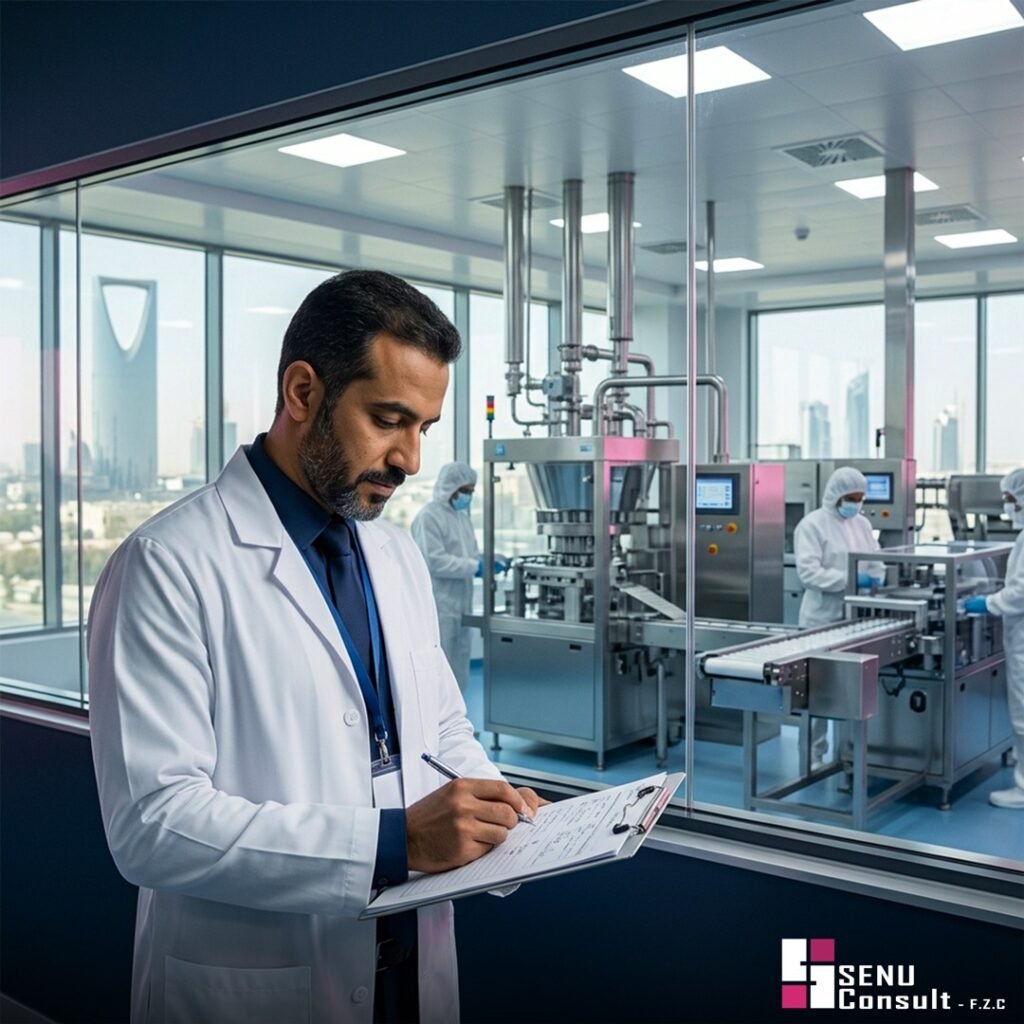
GMP compliance services in Saudi Arabia
GMP Compliance Services in Saudi Arabia: Building Audit-Ready Pharmaceutical Facilities from Day One
GMP compliance services in Saudi Arabia are essential for pharmaceutical investors, factory owners, quality leaders, and operations teams who want to build or upgrade pharmaceutical facilities with confidence. A successful pharmaceutical manufacturing project does not depend only on modern equipment or an attractive facility layout. Instead, it requires a complete compliance-driven approach that connects facility design, quality systems, operational workflows, documentation, qualification, validation, and regulatory readiness.
As Saudi Arabia continues to grow as a strategic pharmaceutical manufacturing hub, investors need more than general consulting. They need a partner who understands how to turn complex GMP requirements into practical, operational, and audit-ready facilities. Therefore, GMP must be embedded early in the project, not added later as a corrective layer.
At Senu Consult, we bridge vision and execution for regulated facilities across the MENA region. Our team supports life sciences and highly regulated industries from concept to compliant start-up, helping clients bring their facilities online faster, safer, and fully compliant.
Learn more about Senu Consult through the official website:
What Are GMP Standards and Why Do They Matter?
Good Manufacturing Practice, commonly known as GMP, refers to a structured set of requirements that ensures pharmaceutical products are manufactured consistently, safely, and under controlled conditions. In simple terms, GMP protects product quality by controlling every process that affects manufacturing.
However, GMP is not limited to the final product. It covers the full manufacturing environment, including facility design, personnel and material flows, cleanrooms, HVAC systems, equipment qualification, documentation, training, standard operating procedures, quality systems, and contamination control.
Because pharmaceutical products directly affect patient safety, every manufacturing step must be controlled and traceable. As a result, companies must prove that each batch has been produced according to approved procedures, inside a suitable facility, and under a robust quality management system.
This is why GMP compliance services in Saudi Arabia are vital for pharmaceutical projects. They help investors and companies avoid fragmented decisions, reduce compliance risks, and create facilities that can pass regulatory inspections with stronger confidence.
In addition, early GMP planning supports future export ambitions. When a facility is designed and operated according to recognized compliance principles, it becomes easier to prepare for local and international regulatory expectations.
Why Pharmaceutical Facilities in Saudi Arabia Need Specialized GMP Support
Pharmaceutical facility projects are complex by nature. They combine engineering, regulatory expectations, process requirements, quality systems, operational readiness, documentation, and inspection preparation. Therefore, one weak decision in the early stage can create serious problems later.
For example, a production area may look suitable in the layout phase. However, once operations begin, the same layout may create problems in personnel movement, material transfer, waste handling, cleaning, or contamination control. Similarly, an HVAC system may be designed without enough operational input, which can later affect pressure control, temperature, humidity, and cleanroom classification.
In other cases, companies may purchase equipment that seems technically acceptable but becomes difficult to qualify or validate. Consequently, start-up timelines become longer, costs increase, and the facility may face unnecessary regulatory risks.
Moreover, regulatory inspections do not only check the physical facility. Inspectors also review the ability of the organization to prove compliance. This includes documentation, procedures, training records, qualification protocols, validation evidence, deviation management, and quality oversight.
For that reason, a pharmaceutical facility must be designed to operate correctly and prove compliance consistently. This is the difference between a facility that is simply built and a facility that is truly operational-ready and audit-ready.
Senu Consult supports clients by embedding GMP thinking into the project from the beginning. Instead of fixing compliance gaps after construction, we help prevent them during planning, design, execution, qualification, and start-up.
Explore our services here:
https://senuconsult.com/services/
Common GMP Compliance Challenges in Pharmaceutical Projects
Although GMP compliance is critical, many pharmaceutical companies face similar challenges during facility development or upgrade projects. In many cases, these challenges do not appear at the concept stage. Instead, they become clear during commissioning, qualification, validation, operation, or inspection.
The first challenge is unclear project requirements. A facility may start with a general design brief without a detailed understanding of product types, production capacity, process risks, cleanroom needs, utilities, containment requirements, or future expansion plans. As a result, the design may need repeated changes later.
The second challenge is the separation between design and operations. In some projects, the engineering team works separately from the quality and operations teams. Consequently, the facility may look well organized on drawings, yet fail to support daily manufacturing activities efficiently.
The third challenge relates to HVAC and critical utilities. Pharmaceutical facilities depend heavily on controlled environments. Therefore, HVAC, water systems, compressed air, steam, and other utilities must be aligned with product needs, process requirements, and GMP expectations.
The fourth challenge is documentation. GMP documentation is not an administrative formality. It is the evidence that proves control. Without clear policies, SOPs, protocols, records, change controls, deviation systems, and qualification documents, a facility cannot demonstrate compliance effectively.
Finally, many facilities are not inspection-ready when operations begin. Even if the building and equipment are installed, the quality system may not be mature enough. Therefore, audit preparation should start much earlier than the inspection date.
Specialized GMP support helps companies avoid these risks and move through the project with a clearer, safer, and more compliant roadmap.
How GMP Compliance Services Reduce Project Risk
GMP compliance services reduce project risk by connecting all technical and regulatory decisions within one structured plan. Rather than making separate decisions for design, equipment, documentation, utilities, quality systems, and validation, the project follows an integrated compliance strategy.
At the beginning, the project team defines the product types, manufacturing processes, regulatory expectations, production capacity, and operational goals. Then, these requirements are translated into facility design, process flows, equipment needs, utility systems, and quality documentation.
In addition, GMP compliance support allows teams to review engineering decisions before construction or procurement. This is important because correcting a design before execution is much easier and less costly than correcting it after installation.
Furthermore, GMP planning improves the readiness of commissioning, qualification, and validation activities. When the design and user requirements are clear, the qualification strategy becomes more efficient. As a result, the facility can move toward operational start-up with fewer delays.
GMP services also strengthen documentation and quality systems. This helps quality and operations teams manage daily activities with consistency. It also gives inspectors clear evidence that the facility is controlled and compliant.
Therefore, GMP compliance is not just a regulatory requirement. It is a practical risk management tool that protects timelines, budgets, product quality, and business continuity.
The Role of Facility Design in Pharmaceutical Compliance
Facility design plays a direct role in GMP compliance. The building layout, process areas, personnel flows, material movements, cleanroom classification, HVAC design, waste routes, and utility systems all influence the ability of the facility to operate in a compliant way.
For example, raw materials must move logically from receiving to storage, dispensing, preparation, manufacturing, packaging, and finished goods storage. At the same time, personnel movement must be controlled to reduce contamination risk. In addition, cleaning routes, gowning rooms, access controls, and waste flows must support GMP requirements.
Cleanroom design also requires careful planning. The facility must define room classifications, pressure cascades, airlocks, surfaces, cleaning requirements, and environmental monitoring needs. These decisions cannot be separated from the process or product.
Moreover, HVAC design must support the required environmental conditions. It must help control air quality, pressure differentials, temperature, humidity, and particle levels where applicable. Therefore, HVAC design should reflect manufacturing needs, not generic assumptions.
A well-designed pharmaceutical facility also considers maintenance access, cleaning, future expansion, and operational efficiency. This reduces long-term costs and prevents unnecessary rework.
Senu Consult provides Facility Design & Project Management support to help clients translate their pharmaceutical vision into compliant and operational reality. Our approach focuses on connecting design with daily operations from the earliest project stages.
Cleanrooms and HVAC: Critical Foundations for GMP Compliance
Cleanrooms and HVAC systems are among the most important elements of GMP compliance in pharmaceutical manufacturing. This is especially true when facilities produce sterile, sensitive, or contamination-prone products.
A cleanroom is not just a clean space. It is a controlled environment designed to reduce contamination risk and support consistent manufacturing. Therefore, cleanroom planning must consider classification, pressure control, personnel flows, material transfer, airlocks, finishes, cleaning procedures, monitoring points, and operational behavior.
In addition, the cleanroom must be practical. If the layout is too complex, operators may struggle to follow procedures consistently. As a result, the facility may face higher deviation rates and increased compliance risk.
HVAC systems support cleanroom performance by controlling air movement and environmental conditions. They help maintain pressure relationships, temperature, humidity, filtration, and air change rates. For this reason, HVAC design, commissioning, and qualification must be aligned with GMP expectations.
If cleanroom or HVAC design is weak, the facility may experience serious problems during qualification or inspection. For example, pressure instability, poor airflow patterns, uncontrolled temperature, or inadequate monitoring can delay start-up and create regulatory concerns.
Therefore, GMP, engineering, quality, and operations experts should work together early. This integrated approach allows the facility to meet compliance requirements while remaining practical for daily production.
CQV as a Core Element of GMP Compliance
Commissioning, Qualification, and Validation, often referred to as CQV, are essential parts of GMP compliance. A pharmaceutical facility must not only be built according to design. It must also prove that systems, equipment, utilities, and processes work as intended.
Commissioning confirms that systems and equipment are installed and operate according to the design and technical requirements. Qualification provides documented evidence that critical systems meet defined specifications. Validation confirms that processes can consistently deliver the required outcome.
For example, HVAC systems, water systems, compressed air, production equipment, cleaning processes, and computerized systems may require qualification or validation depending on their impact on product quality. Each activity must be planned, executed, documented, reviewed, and approved.
A weak CQV strategy can delay commercial start-up. It can also create inspection findings if the documentation does not support the facility’s claims. Therefore, CQV planning should begin during design, not after construction.
Senu Consult supports Commissioning, Qualification, and Validation as part of its integrated facility development services. This helps clients move from design to compliant operation with clearer evidence, stronger control, and fewer start-up risks.
How Pharmaceutical Facilities Can Prepare for Regulatory Inspections
Regulatory inspection readiness begins long before the inspection date. Every design decision, SOP, training record, qualification protocol, validation report, and quality record contributes to the overall compliance picture.
To prepare effectively, pharmaceutical facilities must first define the applicable regulatory requirements. Then, they need to build a quality management system that supports daily compliance. This includes document control, training, deviation management, CAPA, change control, complaint handling, supplier qualification, internal audits, and management review.
In addition, SOPs must reflect actual operations. If procedures do not match the way people work, inspectors may identify gaps between documentation and practice. Therefore, practical and accurate procedures are essential.
Training is also important. GMP compliance depends on people, not only systems. Operators, supervisors, engineers, quality teams, and management must understand their responsibilities. As a result, training should be continuous, documented, and linked to job roles.
Internal audits also strengthen inspection readiness. They help the organization identify gaps, correct issues, and improve systems before external inspection. Therefore, audit preparation should become part of the facility culture.
Senu Consult supports Regulatory Audit Preparation and QMS Optimization to help clients strengthen inspection readiness and long-term compliance performance.
Why You Need an Execution Partner, Not Just a Consultant
In pharmaceutical facility projects, theoretical advice is not enough. A company may understand the requirements but still struggle to implement them in a real facility. Therefore, investors and pharmaceutical leaders need a partner who can connect compliance knowledge with engineering execution and operational reality.
The right partner does not simply prepare reports. Instead, they help the client make practical decisions. They review design from an operational perspective, support equipment and systems planning, define qualification needs, strengthen documentation, and prepare the facility for inspection and start-up.
This is where Senu Consult creates value. We focus on bridging the gap between design and operations. Our goal is to help clients build facilities that are “Born Operational from Day One.” In other words, the facility should not only be completed physically. It should also be ready to operate safely, efficiently, and compliantly.
By choosing an integrated partner, companies reduce the risk of delays, rework, and fragmented decisions. They also gain a clearer path from concept to commissioning and commercial readiness.
To speak with the Senu Consult team, visit:
https://senuconsult.com/contact-us/
Senu Consult GMP Compliance Services
Senu Consult offers integrated services that support GMP compliance for pharmaceutical facilities in Saudi Arabia, UAE, and the wider Middle East. These services are designed to cover the full project lifecycle, from concept to compliant start-up.
Our support includes facility design and project management, end-to-end facility development, facility design optimization, equipment and systems procurement, commissioning, qualification, validation, sustainability integration, quality management, QMS optimization, supplier audit frameworks, and regulatory audit preparation.
In addition, we support regulated organizations with governance, technical training, and compliance capability building. This is important because a successful pharmaceutical facility needs more than equipment. It needs people, systems, procedures, and leadership aligned around quality and compliance.
Through our experience in life sciences and regulated facilities, we help clients translate complex technical and regulatory requirements into practical actions. This makes Senu Consult a strong partner for investors, pharmaceutical companies, quality managers, and operations leaders who need reliable execution support.
You can explore the industries we serve here:
https://senuconsult.com/industries-we-serve/
When Should You Request GMP Compliance Support?
The best time to request GMP compliance support is at the earliest stage of the project. Early involvement helps the project avoid design gaps, unclear requirements, unsuitable equipment choices, and weak documentation strategies.
During the concept stage, GMP support helps define the facility requirements, manufacturing strategy, product risks, production capacity, and regulatory roadmap. During the design stage, it helps review layouts, flows, cleanroom needs, HVAC concepts, and utilities. During execution, it helps reduce non-compliance risks and supports decision-making.
For existing facilities, GMP support is also valuable. It can help identify gaps, improve the quality management system, prepare for inspections, support expansion plans, upgrade documentation, or strengthen CQV readiness.
Therefore, GMP compliance services are not limited to new factories. They are equally important for operating facilities that want to improve performance, prepare for regulatory inspection, enter new markets, or reduce compliance risk.
If your company is planning, building, upgrading, or preparing a pharmaceutical facility for inspection, a structured GMP assessment can help you move forward with confidence.
How to Choose the Right GMP Compliance Partner in Saudi Arabia
Choosing the right GMP compliance partner is a strategic decision. It can affect the facility’s timeline, budget, inspection outcome, and long-term performance. Therefore, companies should evaluate more than cost.
First, the partner should have strong experience in pharmaceutical and regulated environments. Second, they should understand the connection between facility design and operational readiness. Third, they should support the full lifecycle, from concept to start-up, rather than focusing on one isolated stage.
In addition, the right partner should understand CQV, quality management systems, regulatory audit preparation, cleanroom design, HVAC considerations, and practical manufacturing needs. They should provide actionable solutions, not only general recommendations.
Regional understanding is also valuable. Pharmaceutical projects in Saudi Arabia, UAE, and the wider Middle East require awareness of local business expectations, regulatory direction, and growth ambitions. As a result, an experienced regional partner can support both compliance and commercial readiness.
Senu Consult combines engineering, regulatory, quality, and operational expertise to help clients build facilities that are compliant, sustainable, and ready for performance.
Benefits of Early Investment in GMP Compliance Services
Early investment in GMP compliance services in Saudi Arabia protects pharmaceutical projects from costly delays and rework. Although some companies view compliance support as an added cost, it often prevents much larger expenses later.
The first benefit is better inspection readiness. When the facility is designed and documented correctly, the organization can present stronger evidence during regulatory review. The second benefit is faster operational start-up. Because requirements are clear, teams spend less time correcting avoidable gaps.
The third benefit is improved product quality. GMP-driven systems reduce variation, support process control, and strengthen consistency. This protects the company’s reputation and supports patient safety.
The fourth benefit is stronger scalability. A compliant and well-designed facility can support future expansion, additional product lines, technology upgrades, and export readiness more effectively.
Finally, early GMP planning gives investors better visibility. Clear requirements, defined responsibilities, structured documentation, and integrated execution make the project easier to manage.
Therefore, GMP compliance is not only about passing inspections. It is about building a facility that can operate reliably, grow sustainably, and compete confidently.
Senu Consult: From Vision to Compliant Operation
Senu Consult believes that successful pharmaceutical facilities are not created by design alone. They are created by aligning design, operations, compliance, quality systems, and execution. This is why we help clients bridge vision and execution across regulated facility projects.
Our approach supports operational readiness from the earliest project stages. We help clients avoid design-operation mismatches, reduce start-up risks, and build facilities that can operate with confidence.
Whether you are planning a new pharmaceutical manufacturing facility, upgrading an existing plant, preparing for inspection, or improving GMP systems, Senu Consult can support your journey from concept to commissioning and compliant start-up.
With a focus on engineering precision, GMP compliance, sustainability, and audit-ready performance, we help regulated industries across the MENA region turn facility vision into operational reality.
Start Your Pharmaceutical Project with Confidence
GMP compliance services in Saudi Arabia are not an optional add-on for pharmaceutical manufacturing projects. They are a foundation for quality, inspection readiness, operational control, and long-term business success.
By embedding GMP from the beginning, your facility can reduce compliance risk, improve start-up readiness, strengthen quality systems, and prepare for sustainable growth. With Senu Consult, you gain a partner who understands both regulatory expectations and operational execution.
If you are planning to build, upgrade, or prepare a pharmaceutical facility for inspection, contact Senu Consult today.
Contact Senu Consult
Website: https://senuconsult.com/
Email: info@senuconsult.com
Phone: +971566360153
Request a Consultation
https://senuconsult.com/contact-us/